“We burn this city everyday.”



“We burn this city everyday.”
A class I’m teaching:
Senior Seminar: Riot and Rebellion in American Literary History
On the occasion of the 50th anniversary of July 1967—an event still alternately called a “riot” or a “rebellion,” with very different meanings implied by each word—this class will explore urban uprisings in American literature. The class is bookended by literary and cultural responses to Detroit 1967, but in between we’ll explore the draft riots of the Civil War era, which includes the 1863 Detroit riot, the Haymarket “riot” of 1886, the “Red Summer” of 1919, the Watts uprising of 1965, and the Ferguson and Baltimore riots of recent years.
Required Readings:
Charles Chesnutt, The Marrow of Tradition
John Hersey, The Algiers Motel Incident
Frantz Fanon, The Wretched of the Earth
Walter Mosley, Little Scarlet
Course Schedule
Jan. 10: Claude McKay, “If We Must Die,” Juliana Spahr, “Turnt,” Margaret Danner, “Garnishing the Aviary,” Langston Hughes, “Beaumont to Detroit: 1943,” Dudley Randall, “Ballad of Birmingham,” Bill McGraw, “Riot or rebellion? The debate over what to call the 1967 disorder continues”
Listen: Martin Luther King, Jr., “The Other America,” Stanford University, Apr. 14, 1967; John Lee Hooker, “The Motor City is Burning,” and the cover by the MC5, The Clash, “White Riot”
To watch in class: Gangs of New York (excerpt on the 1863 draft riots)
Jan. 17: Read: Gwendolyn Brooks, Riot (Broadside Press, 1969), Kerner Commission, pp. 1-13, Philip Levine, “They Feed They Lion,” Marvin Jackmon, “Burn, Baby, Burn”
Listen: The Trammps, “Disco Inferno,” Gil Scott-Heron, “The Revolution Will Not Be Televised,” Marvin Gaye, “What’s Goin’ On,” The Rolling Stones, “Street Fighting Man,” The Damned, “Smash It Up”
Jan 20: Writing exercise 1 due on Blackboard: keyword analysis
NB: Mon., Jan 23 is the last day to drop classes with tuition reimbursement.
Jan. 24: John Hersey, Algiers Motel Incident, pp.7-37, 63-142, 157-204
Listen: The Impressions, “The Young Mod’s Forgotten Story”
Jan. 31: John Hershey, The Algiers Motel Incident , 219-293, 304-326, 345-352, 379-385, 392-394
Listen: Smokey Robinson and the Miracles, “I Care About Detroit,” Ice Cube, “We Had To Tear This Mothafucka Up”
NB: Classes dropped by Feb. 5 will not appear on your transcript.
Feb. 7: Broadside/Lotus/Third World Press: Selected poems by Dudley Randall, Carolyn Rodgers, and Naomi Lane Madgett, Melba Boyd, Roses and Revolutions, Chapter 1
Listen: Sly and the Family Stone, “There’s a Riot Goin’ On,” The Bar-Kays, “Son of Shaft” (from the Wattstax film)
Feb. 9: Writing exercise 2 due on Blackboard: unpacking simile, metaphor, and symbol
Feb. 14: Frantz Fanon, “On Violence,” Ta-Nehisi Coates, “Barack Obama, Ferguson, and the Evidence of Things Unsaid,” Jonathan Chait, “Obama, Ferguson, and the Torments of Liberalism,” George Cicciarello-Maher, “Riots Work,” Salon, Brittney Cooper, “America’s New Racial Low Point,” Salon, Dudley Randall, “Sniper”
Listen: Run The Jewels, “Thieves”
Feb. 21: Walter Mosley, Little Scarlet
Listen: Junior Murvin, “Police and Thieves,” The Clash, “Police and Thieves”
Feb. 28: José Martí, “A Terrible Drama,” William Dean Howells, “Clemency for the Anarchists,” Caleb Crain, “The Terror Last Time,” The New Yorker, Lucy Parsons, “I Am An Anarchist”
Listen: Hazel Dickens, “Rebel Girl” (lyrics by Joe Hill), Bikini Kill, “Suck My Left One”
Mar. 7: Meet at the Burton Collection, Detroit Public Library
Read: A Thrilling Narrative From the Lips of the Sufferers of the Late Detroit Riot, Glenn Hendler, “Feeling Like a State: Writing the 1863 New York City Draft Riots”
Listen: Ice Cube, “When Will They Shoot?”
Mar. 9: Writing exercise #2 due: 1-page critical summary of an archival image or text
Mar. 14: No class-spring break
Mar. 21: Charles Chesnutt, The Marrow of Tradition; material from the Norton critical edition: “1898 Wilmington Riot Commission Findings,” “Hell Jolted Loose,” Negro Rule Ended, Washington Post (Nov. 11, 1898)
Mar. 28: Chesnutt, The Marrow of Tradition; “Sheet Music from the 1890s,” “Dusky Dinah: Cake-Walk and Patrol,” “Way Down South: Characteristic March, Cake-Walk and Two-Step”
Apr. 4: Watch: Zoot Suit
Read: Catherine Ramírez, “Saying “Nothin'”: Pachucas and the Languages of Resistance”
Apr. 11: Suzanne Smith, Dancing in the Street, “’The Happening’: Detroit, 1967”; Scott Saul, “What You See Is What You Get”: Wattstax, Richard Pryor, and the Secret History of the Black Aesthetic (focus on section 3, “As Real as Real Can Get,” and watch the accompanying clip
Listen: Martha and the Vandellas, “Dancing in the Street”
Thesis workshop part 1
Apr. 18: Watch: Finally Got the News
Thesis workshop part 2
George Cicciarello-Maher, a brilliant political theorist at Drexel, has been the target of a right-wing harassment campaign led by the sorry likes of Mike Cernovich and Breitbart media. In a very short-sighted, weak response to this Twitter outrage campaign, Drexel issued a statement disavowing George, calling his statements on Twitter “reprehensible,” and suggesting some sort of discipline to come. I’d encourage everyone to push back against Drexel’s ill-advised response to a very loud, increasingly organized online mob. It’s hard to understand what Drexel think it’s accomplished here: if the university had simply ignored the Christmas Eve rantings of professional bigots on Twitter, it would all be forgotten by now. The story only still exists because Drexel issued a statement. This is either very poor media relations practice or something more ominous.
Feel free to copy the letter below, or change it. The addresses you need are:President John Anderson Fry (jaf@drexel.edu), Provost M. Brian Blake (mbrian.blake@drexel.edu), and Executive Director of Media Relations Niki Gianakaris (ngianakaris@drexel.edu).
I am writing in distress and disappointment over Drexel’s recent statement castigating Dr. Cicciarello-Maher for his tweets mocking the racist fantasy of “white genocide.” This term refers to a belief that policies promoting racial diversity, immigration, and religious tolerance–all values which Drexel purports to defend–amount to genocidal campaign against “white culture.” Cicciarello-Maher added later that the slave revolt in Haiti was a “very good thing indeed”–a claim about which there can be little serious argument, at least at a reputable institution of higher learning.
The controversy was quite deliberately fabricated by Mike Cernovich, a notorious conspiracy theorist with a widespread following on the racist right. As I have seen on Twitter, the voices clamoring for Dr. Cicciarello-Maher’s firing are almost uniformly vile–open anti-semites, white nationalists, neo-Confederates, and other political bottom-feeders. I wish I could understand what Drexel hoped to accomplish by appeasing a far-right campaign against one of its faculty. If the idea was to make the “controversy,” such as it was, go away, you have clearly not succeeded in this regard. Indeed, bending to an obscene mob only emboldens it–and encourages future campaigns of harassment against members of the Drexel community.
I am proud to count George as a colleague. I know that his research and pedagogy are first-rate, brave, insightful, and open-minded–adjectives I cannot apply to the mob calling for his firing, or even worse. Drexel is very lucky to count him on its faculty. For this reason, I hope that your meeting with Dr. Cicciarello-Maher will be a productive discussion on how to extend the values of academic freedom to free-wheeling precincts of social media where it needs protection.
Sincerely,

Synergy, n: 1) Joint action, cooperation; esp. (Theol.) cooperation between human will and divine grace in the work of regeneration. 2) Any interaction or cooperation which is mutually reinforcing; a dynamic, productive, or profitable affinity, association, or link.
Yea, there should be a Synergie, and conspiration of all Arts and Sciences to advance Theology, which makes the better Part of us happy.
–George Thomson, Galeno-pale, or, A chymical trial of the Galenists, that their dross in physick may be discovered with the grand abuses and disrepute they have brought upon the whole art of physick and chirurgery, 1665
It’s not real…it’s an illusion!
–Jem, 1985
My most recent rejection letter regretted to inform me that due to a large number of applications, the selection committee was forced to place “a premium on intellectual synergies.”
The form-letter writers used the plural form of a noun whose use in business circles peaked in the 1990s and early 2000s. “Synergies,” is often a precious version of “sympathies” or “compatibility.” “Synergy,” in the singular, meant something more grandiose: organizational harmony, efficiency, the achievement of a unity that is greater than the sum of its parts. Now, however, “synergy” regularly appears on listicles about buzzwords to avoid—one consultant interviewed by Forbes complained that “it never fails to make me think of my wife’s childhood obsession with Jem and the Holograms.” Let us follow this thread for a moment.

Mild-mannered Jerrica, as you may recall, turned into Jem via a powerful Holographic machine/talking computer named Synergy. Synergy described herself as “the ultimate audiovisual synthesizer” with the power to project realistic holograms onto physical objects. With just a tug on her earring (which was actually a miniature remote holographic projector) Synergy could project the image of Jem and the Holograms onto Jerrica and her otherwise square friends. All she had to do was say, “Showtime, Synergy!” Watch as Jerrica meets Synergy for the first time.
“It’s not real…it’s an illusion!”
Jem’s Dad’s invention’s synthesis of the aural and visual field hits on the fanciful, even utopian connotations once carried by the word before it became a buzzword in mergers and acquisitions. The word’s common definition, according to the OED, is “any interaction or cooperation which is mutually reinforcing,” like Jem and her Holograms. By contrast, the Misfits, the Holograms’ archenemy, were often undone by the rifts in their organization between ruthless rich girl Pizzazz and Stormer, who Wikipedia refers to as the “sensitive keytar player” (is there any other kind?) who lacked the killer instinct to destroy her rival group.

Most early uses of “synergy” were biological, referring to the coordinated action driving animal bodies, cells, and organs. The “synergy” of human gestation was an especially common usage, which takes on added significance given that Jerrica’s dad programs Synergy with her deceased mother’s voice and likeness, as Renee Angle notes. Synergy’s other meaning is theological, much like “innovation.”: “synergy” in a Protestant sense referred to “cooperation between human will and divine grace.” If innovation once referred negatively to the hubris of self-appointed prophets who claimed to speak God’s will, “synergy” was its humble, virtuous opposite: the co-partnership of human and divine effort, God’s collaboration with us.
The word came into wider use in the 20th century via Lester Ward, an ex-botanist and paleontologist who became the first president of the American Sociological Association. A self-taught disciple of the positivist thinker Auguste Comte, he coined “synergy” to describe a governing principle of all social structure. Synergy, wrote Ward, was the dynamic clash of opposing forces in nature, as well as human social structures. (In 1905, bored with his work at the Smithsonian, he wrote to the president of Brown University to inquire about the possibility of teaching sociology there. Brown’s president apparently said “sure.” In this era of the academic job market, intellectual synergies were easier to come by.)
Like many of today’s entrepreneurship-and-innovation hucksters, who hunt for validations of contemporary business cant in history and the natural world, Ward saw synergy as a biological principle that also governed social life. Ward’s descendants are writers like Steven Johnson, a bestselling author in the popular-science-cum-business-advice genre. In books like Where Good Ideas Come From: The Natural History of Innovation, he argues that there are seven typologies for optimal, innovation-friendly environments, which can be observed across nature and across time (in order to understand where good ideas come from, Johnson writes, “we have to put them in context.” At the same time, evolutionary “innovation” in a coral reef and the diffusion of ideas on the Internet are analogous concepts. So much for context.) Or Bill O’Connor of the Innovation Genome Project, an organization whose name also suggests a biological drive to “innovate.” In all of human history, says O’Connor, there have only been seven kinds of questions that have driven all innovations. Only seven. (The sacramental number seven is popular in this genre, suggesting that there may be cultural, rather than scientific, forces at work here.)
Synergy’s first real vogue, though, came in the 1960s: one of its earliest appearances in the US media came in a 1966 New Yorker profile of Buckminster Fuller. Fuller’s utopian, eccentric projects—the Dymaxion car, the geodesic dome—came from a modernist conviction that technological advances could render obsolete the social problems of penury and waste. We could, in effect, engineer our way out of inequality and war. Synergy, or what he called “synergetics,” was the science and faith of this conviction. The example Fuller gave the reporter in his profile was chromium-nickel-iron alloys, which together held up against much more intense heat than their constitutive elements could have done. This “invisible pattern” was synergy, “a term,” the author explained, “that can be defined as the behavior of whole systems in ways unpredictable by the individual behavior of their sub-systems.”
There was thus a degree of serendipity in these unpredictable, invisible patterns yet to reveal themselves. And the social possibilities they might allow were just as consequential. Alloy steel’s resistance to heat made it very popular for the twentieth-century war machine, Fuller lamented. But if this synergy were applied not to weaponry, but to housing and education—what Fuller called “livingry”—it could work wonders. As the New Yorker put it with now-quaint confidence: “the shift of industry to the new invisible base has brought about such spectacular gains in over-all efficiency, such demonstrated ability to produce more and more goods and services from fewer and fewer resources, that mankind as a whole has inevitably profited.”
Synergy gained further currency in the work of Abraham Maslow, the organizational psychologist who used it to describe the ideal state in which the interests of an employee and his boss are harmonized at work. Borrowing the term from the anthropologist Ruth Benedict, Maslow defined synergy as
the social-institutional arrangements which fuse selfishness and unselfishness, by transcending their oppositeness and polarity so that the dichotomy between selfishness and altruism is resolved and transcended and formed into a new higher unity.
Here, we might once again call upon Jerrica’s holographic alter ego to point out that workplace synergy, as Maslow describes is here, is fundamentally not real life. “Synergy” is more often just a mask.

What is it hiding in business jargon? Mergers are thought be bring synergy (or “synergies”) to companies that on their own lack economies of scale or product they would gain in a merged firm. Maslow’s “higher unity” ideal was already rolling eyes in 1989, when Steve Lohr in the New York Times quoted a McKinsey executive: “synergy in most cases is another name for head-count reductions.” (“Head-count reductions,” of course, is another name for “you’re fired.”)
This is where “synergy” enters the austerity lexicon of today’s economy. Unlike “lean,” “flexible,” and “nimble” management, which are ways of dressing up the vulnerability and disposability of workers in a language of efficiency, “synergy” dresses up the vulnerability of executives in a language of unity. For this reason, its exuberant usage was always defensive, tinged with a bit of dread. It’s a dread displaced by that Forbes consultant onto his wife’s childhood cartoon obsession. One anonymous investor in 1989 put it this way: ‘All this management gobbledygook is to mask the real issue,” he said, “which is that these companies are afraid of being taken over by someone who will get rid of the current crop of executives.”
Showtime, synergy!

A great film, about which so much can and should be written, but: this clip basically sums up most of what this blog has to say about the fantasy and morality of innovation. The new motto of Keywords for the Age of Austerity:
“And the motherfuckers who deal with intangibles are the motherfuckers who are rewarded in society”
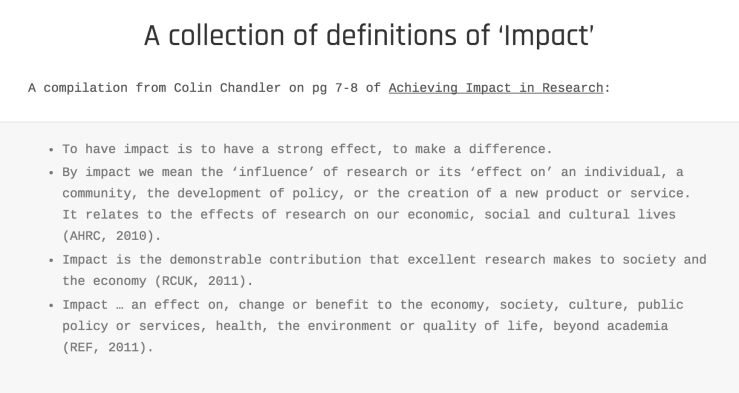
To have “impact,” it seems, is to have impact. Via Mark Carrigan:
In my last post, I wrote about the way Trump supporters at the University of Michigan have borrowed a language of multiculturalism to frame their far-right political choices as a vulnerable identity. One group of Trump-voting Wolverines sent a petition to University President Mark Schlissel, complaining that his post-election statements on intolerance and bigotry in the Trump campaign amounted to “bias” and “intimidation” against them. The pro-Trump students’ framed their unpopularity on college campuses as a kind of minority position, any criticism or opposition to which then constitutes a threat to “diversity.” And some of their supporters agreed, under the tortured logic that if intolerance is bad, then intolerance for intolerance must also be bad. No tolerance for intolerance of intolerance!
This is confusing and galling for any number of reasons, the most important of which is that the Ann Arbor campus has seen a rise in incidents of white-supremacist intimidation over the last few months. If anyone is looking for intimidation, they should look there.
Dr. Schlissel didn’t help matters, recently issuing a statement that appeared to equate actual incidents of racial intimidation against Michigan students with criticism of Trump voters’ racism:
We saw a threatening message painted on the rock near our campus; a student walking near campus was threatened with being lighted on fire because she wore a hijab; another student left his apartment to go to class and found a swastika with a message telling him to go home. Some students have also been shouted at and accused of being racist because of their political views.
Some students are threatened with murder by racists; others are shouted at for being racist.
The pro-Trump students’ campaign against the supposed “bias” against them (again, read: their unpopularity) reached a kind of absurd crescendo, when Amanda Delekta of the College Republicans met with Dr. Schlissel and requested a “unity campaign,” as reported recently in the New York Times. This is what also gets me: the Trump-voting students position themselves as an activist faction, borrowing a sort of posture or attitude from the left. But at the same time, they expect the university administration to embrace them for doing so. At no point in my own career as an activist on college campuses did it ever once occur to me that I should expect the enthusiastic endorsement of the college president as a precondition.
When Ms. Delekta met with Michigan’s president, Dr. Schlissel, she brought Enrique Zalamea, president of the College Republicans, along with her. They proposed a kind of unity campaign for campus, in which students would march with signs saying, “I am a Wolverine,” to stress their similarities.
And they suggested some TED-type sessions on inclusivity and diversity.

But in borrowing some of the terms (diversity, inclusion, community) and the posture (an activist faction silenced by the administration) of student activists of the left, these students cleverly appropriate the discourse of the liberal university for illiberal ends. The ease with which this can be accomplished only emphasizes the importance of efforts at places like Swarthmore College, which aim to push institutions way from ineffectual bromides about “values” and “diversity” and “unity” and into clear public positions on its obligations to vulnerable student populations.
Mark Schlissel of the University of Michigan recently waded into a minor controversy when he told students at a post-election vigil, “Ninety percent of you rejected the kind of hate and the fractiousness and the longing for some sort of idealized version of a nonexistent yesterday that was expressed during [Trump’s] campaign.” Predictably, some portion of that other 10%–those who voted Trump—accused Schlissel of bias and intimidation. (Remember the 1990s, when liberals were supposed to be the over-sensitive ones?)
Meanwhile, white-supremacist propaganda has been posted across the Ann Arbor campus, advocationg “white pride” and denouncing inter-racial dating.
Hey y’all. This is currently what’s being passed around and posted here on campus smh pic.twitter.com/Nb2DMJov2A
— #BBUM (@THEBSU) September 26, 2016
And as protests erupted nationwide in response to Trump’s victory, there was crowing on the right and some chiding from liberals. The election is over, some say, and “it’s time to buck up”; don’t become the hate you condemn, says the hapless comedian Trevor Noah; We must give Trump a chance, say others like President Obama, never quite explaining just what this means. A chance to do what?
More recently, Noah invited right-wing talking head and “white supremacist voicebox” Tomi Lahren to have a healthy debate about her claims that Black Lives Matter is a moral equivalent to the KKK. IN other words, writes David Dennis, ” Lahren spouted violent propaganda on national television while Noah tried to get her to value his black life.” And after words, they praised each other for their civility.
Thank you for being my guest Tomi. Our goal should be to destroy these “bubbles” not each other. You’re always welcome on my show. https://t.co/AairL3cdAy
— Trevor Noah (@Trevornoah) December 1, 2016
These exhortations to “give Trump a chance,” listen to the “other side”–even when the other side is barbaric–are the sad, festering remains of “bipartisanship” and “civility,” liberal political virtues that grow more irrelevant by the day in the Trump era. “Civility,” you will recall, is nice among neighbors but a losing idea in politics, since it treats a battleground as a peaceable conversation among equally reasonable positions. As an equivocal mode of approaching one’s rivals with charitably good cheer, it has none of the acrimony and the pathos that generally makes for effective political humor. So the fact that Noah stands so squarely for “civility” is a big reason why he isn’t very funny.
Like Trump’s University of Michigan supporters, Noah, Krugman, and many others confuse opposition with “intolerance,” disagreement with intimidation. Ron Fournier, of Crain’s Detroit, is another case in point. He tweeted his disappointment with Michigan opponents of Trump, for their “intolerance” for a position he simultaneously identifies with “hate.”
No tolerance for hate. No intolerance for people who support a person you hate.
Also: It’s a state university in a purple state. https://t.co/51c7Zb0v9X
— Ron Fournier (@ron_fournier) November 16, 2016
His position therefore seems to be: on the one hand, no tolerance for hate. On the other hand, no tolerance for intolerance of hate.
These criticisms indulge in one of the stranger features of our already disastrous political culture. We are told, on the one hand, that the stakes of elections are so high, and then scolded when we act like we believe it. If we take “democracy” seriously—that is, as something other than an expensive excuse to hold election-night parties—then we should encourage the sort of antagonism and anger visible on campuses and in the streets. We should have the courage, at the very least, to say “no,” loudly and disruptively and rudely. We will all also need to forge new ties and alliances outside of our comfort zones, our workplaces, and God help us, our Facebook networks. No one should give Trump a chance–he just might take it.
If you’re attending this year’s MLA conference in Philadelphia, please stop by this panel, featuring Molly Geidel, Patricia Stuelke, George Cicciarello-Maher, and ME. It promises to be great. Abstracts below.
Underdevelopment at Home and Abroad: Aesthetics of Modernization in the Americas 10:15–11:30 a.m., 102A, Pennsylvania Convention Center
One of the most rigid divisions of inter-American cultural geography is that between the so-called “developed” and “underdeveloped” countries in the hemisphere. The language of “development” remains a popular technical and vernacular way of conceptualizing the geography of the American hemisphere. Nevertheless, it has received less critical scrutiny from cultural studies scholars than other related transnational concepts and spaces like the border, the hemisphere, and the plantation. This panel presents work by junior scholars conceptualizing “development” as a hemispheric political practice, ideology, and aesthetic. In line with the presidential theme of “boundary conditions,” these three papers take on one of the most durable political and cultural boundaries of the American hemisphere, as well as the disciplinary borders that have mostly restricted considerations of “development” to the empirical social sciences.
From its origins in the lexicon of post-war British colonial administration to its heyday as a term of Cold War liberalism, “underdevelopment” has been applied nearly uniformly to the global South. For canonical postwar theorists like Walter Rostow, underdevelopment was the result of cultural deficits in the third world; the term’s very syntax spatializes the colonial temporality of backwardness. Postcolonial modernization projects that disseminated the logic of “underdevelopment” were both economic and cultural, characterized by notions of empirical precision and technical agnosticism as well as a dichotomous biopolitical vision of productive v. unproductive life. This panel shifts the geographical focus on underdevelopment from the “third world” to the United States. What kind of subject positions and aesthetic forms has underdevelopment produced in the United States—and not just abroad? How does the cultural policy of development, in institutions like UNESCO and the Fulbright programs, help shape myths of U.S. affluence and Latin American poverty?
Molly Geidel’s paper, “Learning to See Underdevelopment: American Documentary Aesthetics from the Popular Front to the Cold War” traces the transformation of US-produced documentary film from the ambivalent framing of capitalist modernization in New Deal documentary to the more melodramatic, Manichean aesthetic of the early Cold War. Geidel argues that Cold War documentary asserted a sharp contrast between living productively for the future and “living out your days” or “starving slowly” as a member of a stagnant, traditional population.
Patricia R. Stuelke’s presentation, “Dollar Mambo and the Failed Erotics of Development,” explores similar questions of melodrama, nationality, and political expediency in a more contemporary context, in which the project of “development” seems to have failed. Her paper explores the gender politics of development discourse through a reading paper of Paul Leduc’s 1993 film Dollar Mambo, about the 1989 U.S. invasion of Panama. Stuelke argues that the film’s depiction of the body of Manuel Noriega mobilizes a contradictory affective response in its “first-world” viewer: on the one hand, the film activates the frustrated longing for the fraternity that development discourse had promised, as well as the sad and angry realization that the fantasy was no longer possible.
Building on Stuelke’s treatment of the erotics of development’s dream of international “fraternity,” John Patrick Leary’s paper, “‘It Looked Exactly like Mexico’: Latinophilia and the Grammar of Underdevelopment,” argues that mid-century Anglo-American male writers read Latin American poverty as a sign of cultural vitality that U.S. “development” had stifled. Focusing on Jack Kerouac in Mexico and Ernest Hemingway in Cuba, Leary argues that latinophilic fiction dovetailed with the discourse of development, even as it seemed to fetishize “tradition.” Both latinophilia and development, Leary suggests, share a similar tautological grammar. Development, as the name for both a process and its endpoint, has a confounding, circular logic. Likewise, in critiquing the geographical divisions of the hemisphere, latinophilic fiction tautologically confirms a reader’s expectations about it. For example, when Sal, Kerouac’s protagonist in On the Road, crosses the border at Laredo, Texas, he observes: “Just across the street Mexico began…To our amazement, it looked exactly like Mexico.”
Fidel Castro delivered arguably his most famous sentence,”La historia me absolverá” [history will absolve me], 60 years ago, in his speech to the court after the failed 1956 assault on the Moncada barracks. After the revolutionary triumph 3 years later, it offered a mythic origin story of a political career and a political movement, to the degree that the two have always been inseparable. Castro’s death, an occasion for obituary reflections, has logically compelled many to respond to his explicit invitation for historical judgment. Will history absolve him?
The judgment is usually decisive: In 14 y medio, Carlos Alberto Montaner titled his reflection, bluntly, “La historia no lo absolverá.” Even President Obama’s surprisingly measured statement on Castro’s death invoked it, if a bit more evasively than anti-Castro partisans did: “History will record and judge the enormous impact of this singular figure on the people and the world around him.” Most who quote the line from the left do so with an implicit approval: given Castro’s longevity, the revolution’s material achievements, and from the vantage point of savage neoliberalism, history has rendered its judgment of absolution. He has been vindicated.
In the immediate context of the anti-Batista struggle, this judgment is probably indisputable. But in a larger sense, Castro’s longevity has always been the argument against vindication. One can consider the economic fact that in 2016, the island still figuratively “exports sugar to import candy,” as he memorably put it in the “History will Absolve Me” speech. Or as Greg Grandin writes in his intelligent obituary at The Nation, the ongoing privatization of the socialist economy makes one ask whether “all the repression was for naught, with all the old problems that plagued Cuba prior to the revolution having returned.” Even these are complex questions: Cuba’s failure to break its economic dependency doesn’t necessarily constitute a failure of the revolutionary government, since no other country in the Caribbean has fared any better, if they haven’t fared markedly worse.
That the phrase “history will absolve me” is a popular shorthand for this mythic figure is understandable: delivered at the end of his statement to the Batistiano court, it’s a rhetorical triumph for a comandante-en-jefe in the making, marked by the defiance, playfulness, historical expertise, to the point of pedantry, and the tendency for verbosity that distinguished him as a speaker.
The fact is, when men carry the same ideals in their hearts, nothing can isolate them – neither prison walls nor the sod of cemeteries. For a single memory, a single spirit, a single idea, a single conscience, a single dignity will sustain them all.
It’s a brave, moral condemnation of tyranny and a clinic on mocking bravado, as Fidel begs the judges to find him guilty. “Condemn me, it doesn’t matter,” he says before the famous four words–it doesn’t matter, he has already explained, firstly because the judges are irrelevant: I forgive you, you innocent flunkies of a despot, he tells them. Secondly, and most importantly, it doesn’t matter because he is guilty: yes, he did aim to overthrow an unjust tyranny, through means declared illegal by that same tyrant. In every legal sense, he is guilty as charged.
I come to the close of my defense plea but I will not end it as lawyers usually do, asking that the accused be freed. I cannot ask freedom for myself while my comrades are already suffering in the ignominious prison of the Isle of Pines. Send me there to join them and to share their fate. It is understandable that honest men should be dead or in prison in a Republic where the President is a criminal and a thief.
As he approaches the final lines, Castro captures a sense of history as an impersonal but malleable force. Whether Fidel was a Marxist yet or not, “history will absolve me” reflects a historical materialist view of history as a force made by men, but not in circumstances of their own choosing. And yet this materialist view of history redounds to the man himself. Because he lived and held power so much longer, Fidel has been better served by a voluntarist view of historical and revolutionary transformation than his old comrade Che Guevara. But it’s worth remembering the dangers of this fetish for decisive leadership–Guevara’s sad fate is one example of where it can lead, but the masculinist celebration of the determined will, the loudest voice, the visionary is another legacy.

In any case, as Grandin writes, it is Castro’s outsized personality, his longevity, and his own sense of the importance of the leader in history that raises the question of his absolution or condemnation. But if we take the materialist view seriously, “history” is grander than any mortal life, and any ruling it hands down will not be timely.
My ambivalence, I hope, isn’t a liberal perch on the fence. It’s not meant that way, anyhow. But I do like to admit what and when I don’t know. Even if it is apocryphal, Zhou Enlai’s reputed answer to a foreign journalist‘s inquiry on the legacy of the French Revolution seems apt. Will history absolve Fidel Castro? “It’s too early to tell.”
 Keywords: The New Language of Capitalism