
My essay on “best practices,” citizens as “customers,” and the atrocity in Flint was published in Jacobin yesterday. Check it out here!
Author: John Patrick Leary
These are the hands…that do what now?

Pitney Bowes–a company that does something related to the Internet, money, and bar graphs, as far as I can tell–has a new ad campaign, “Craftsmen of Commerce, that sounds like the capitalist’s answer to The Plow the Broke the Plains.
“These are the hands that plow…the data. These are the hands that sow the seeds…of business growth. These are the hands, of Pitney Bowes–Craftsmen of Commerce.”
Keywords for the Age of Austerity 25.5: Meritocracy
“Meritocracy” recently came in via the Suggest a Keyword link, and unlike most of the terms I examine here it is a recent coinage, with an explicit political meaning. Nevertheless, the word has long since has taken on a life of its own, which makes it a complement to the rise of “competencies,” “wellness,” and other means of offloading risk to employees. British sociologist Michael Young invented the word in 1958 in his book, The Rise of the Meritocracy, which adopted a “looking backward” conceit to imagine Britain in 2033, when compulsory schooling and a competitive civil service had replaced the inherited privileges of birth.
Young’s coinage was a portmanteau of “merit” and “aristocracy.” His idea wasn’t that educational notions of merit were displacing the class-based distribution of privileges, but rather replacing them. If privileges and status are distributed through the “talents” nurtured in education, then access to education merely becomes the means of reproducing privilege and status. As Young himself wrote in a 2001 essay denouncing Tony Blair’s embrace of a New Labour meritocracy:
It is good sense to appoint individual people to jobs on their merit. It is the opposite when those who are judged to have merit of a particular kind harden into a new social class without room in it for others. Ability of a conventional kind, which used to be distributed between the classes more or less at random, has become much more highly concentrated by the engine of education.
Young’s point was that Blair had missed the point of meritocracy, embracing the ideal of “merit”–itself an implicitly hierarchical notion that is treated as egalitarian–while forgetting the “aristocracy” part. Young argued that the aristocracy of merit was a new, superficially democratic way of reproducing a class through the school system: “The new class has the means at hand,” he writes, “and largely under its control, by which it reproduces itself.”
This Blairite misidentification of meritocracy is popular in American politics, as well, where it lacks any residue of the class system to which the word originally referred. As Chris Hayes writes, in American politics the meritocratic metaphor of the “level playing field” exerts a powerful, hypnotic pull–it’s a rhetorical point of consensus that “undergirds our debates,” he writes, “but is itself never the subject of them.”
This fondness extends to historical treatments, even of, say, slaveholding Virginia. “Jefferson was always pulling for meritocracy,” writes Andrew Burstein in Democracy’s Muse, a profile of the third president’s republicanism in light of 20th-century politics. Other affirmative uses of the term identify it with a kind of benevolent, hierarchical efficiency. Singapore, where meritocracy, pragmatism, and technocracy are an official governing ideology, is often praised as a model nation in this regard. Sometimes the authoritarian logic of meritocracy is not disguised at all, as in William A. Henry, III’s In Defense of Elitism. Henry, The Third uses “meritocracy” in Young’s sense of an aristocracy of “merit,” but here favorably, in a right-wing polemic against affirmative action.
Skeptical treatments about meritocracy, meanwhile, often tend to treat it as a myth or an aspiration–the common alliterative phrase “myth of meritocracy” sometimes seems to suggest an ideal that, if only realized, would produce an egalitarian society. Other critics like Lani Guinier, whose recent book on inequality in higher education is titled The Tyranny of the Meritocracy, use the term in more purely pejorative sense.
Tyler Cowen, whose book Average is Over rather gleefully images a future society (iWorld, he calls it) divided by mastery of computing technology, imagines a “hyper-meritocracy,” a concept apparently coined by the Japanese sociologist Honda Yuki. Unlike traditional meritocracy, ostensibly distributed through the educational system and measured in examinations, Honda’s “hyper-meritocracy” describes an unstable neoliberal workplace, where the dangers of of layoffs and redundancy are ever-present. A hyper-meritocracy demands not just up-to-date skills, but competencies (see KFTAOA 25 on this)–“all the skills that are flexible, and rooted deeply in an individuals’ personality and emotional makeup,” Honda writes (as translated and quoted in Katsuya Minamida’s Pop Culture and the Everyday in Japan). Cowen writes early in his book, laying out the problem (though he doesn’t appear to see it as much of one):
If you and your skills are a complement to the computer, your wage and labor prospects are likely to be cheery. If your skills do not complement the computer, you may want to address that mismatch.
If you misread “complement” as “compliment,” as I initially did, Cowen’s blithe and breezy description of a dictatorship of technological “competencies” sounds like it is narrated by HAL in one of his more tender moments. “What are you doing, Dave? Why don’t your skills compliment the computer?”
Keywords for the Age of Austerity 25: Competencies
Keywords for the Age of Austerity is a series on the vocabulary of inequality. Certain words, as Raymond Williams wrote in his 1976 classic Keywords: A Vocabulary of Culture and Society, bind together ways of seeing culture and society, shaping and reflecting the world in which they are made. Some of the words I consider here are old terms that have developed a new meaning in recent years; others are recent coinages. All of them relate to affinity for hierarchy and a celebration of the virtues of competition, “the marketplace,” and the virtual technologies of our time. This series explores the historical meanings embedded in these words as well as the new meanings that our age has given them.
Suggest an austerity keyword via the link at left or via Twitter @johnpatleary.
The Keywords mailbag is heavy with “competencies,” a word many people seem to dislike for at least a couple of reasons. First is its buzzwordy pretension and the clumsy pluralization of what has most often been a mass noun (competence or, in some cases, “competency.”) “Competencies” is a cumbersome substitute for “skills,” just as “curator” is a needlessly grand way to say “guy who owns a store.” Second is the association with “deliverables,” “outcomes,” and “accountabilities,” words that reduce professional activity to a set of repeatable, quantifiable tasks. Unlike these, “competencies” seems to come with its own critique built in. One reader writes: “When did “competent” go from a synonym for mediocrity to a term of praise?”
This reader, however, clearly does not read the Harvard Business Review. So where did “competencies” come from? And what did it do with “skills”?
Continue reading “Keywords for the Age of Austerity 25: Competencies”
English 8001: Innovation: A Cultural History of the Contemporary Concept
This is the syllabus of a course I’m teaching this term at Wayne State.

English 8001: Innovation: A Cultural History of the Contemporary Concept
Tuesday 3:00-5:45, State Hall 303 (subject to change)
Professor John Patrick Leary
Email: jpleary@wayne.edu
Office: 5057 Woodward, #10201
Office Hours: Tuesdays 12-2, or by appointment. Office hours are designated times when I am available to meet with students one-on-one. These hours are for you to use as you wish, whether you want to discuss the readings or your own woek, wish to make some special request (like letters of recommendation), or just to chat informally.
“Innovation” is a word on nearly everybody’s lips: it is the rare term that finds favor in both university classrooms and corporate boardrooms, in all parts of the country, in opposing political parties, and in a variety of professions. Silicon Valley CEOs, academics, humanitarian organizations, and even Christian pastors all profess a passion for “innovation” and a desire to nurture it. Despite its modern vogue, however, it is a term with a long and surprising history.
Originating as a pejorative term for religious heresy in early modern Europe, “innovation” is increasingly synonymous with “creativity,” making it a focal point for the intersection of business and aesthetics. Despite its contemporary importance, however, its history is relatively unstudied. This class will start to fill in these gaps by asking the following questions: What is the history of this concept, and what is behind the dramatic shifts in its meaning? What links “innovation” and past mythologies of American capitalism?
We will explore “innovation” as one of what the literary scholar Raymond Williams calls “keywords”: “binding words,” elements of a living vocabulary that shape and reflect what a society holds in common. In this class, we will explore the historical meanings embedded in language we use everyday.
Required texts:
Raymond Williams, Keywords: A Vocabulary of Culture and Society
Wendy Brown, Undoing the Demos: Neoliberalism’s Stealth Revolution
Benjamin Franklin, The Autobiography of Benjamin Franklin
Joshua Ferris, Then We Came to the End
Mark Twain, A Connecticut Yankee in King Arthur’s Court
Caroline Kirkland, A New Home, Who’ll Follow?
Katherine Losse, The Boy Kings
Optional, and preferably stolen: Hanley Christensen, The Innovator’s Dilemma
Requirements:
Research presentation: On February 2, each student should be prepared to present on an instance of “innovation” in a literary or newspaper database of your choosing. You should also turn in a brief (2-4 page) critical analysis of the text you choose.
In-class participation and the Keywords method: This is a small seminar, and for it to work everyone needs to be not only physically present, but intellectually present as well. So each day, I will go around and ask everyone to speak a bit on the relevance of a keyword, which you will choose at the beginning of the term, to the readings that day. You should use Williams’ Keywords to trace, throughout the class readings, a keyword cognate from Williams’ text. Since Williams does not mention “innovation” itself, we will pick keywords that are related to the concept and the readings: for example, “society,” “creativity,” “capitalism,” or “management.” Come prepared to use their chosen concept as a tool to understand the readings. You do not need to spectacularly and brilliantly synthesize everything, but rather use the keyword to ask specific questions about a particular text or broader questions about connections and contradictions between them. What questions does Williams help you ask? How does it help you work through the concepts in the readings? What kinds of questions do the readings ask that Williams does not? How, for example, does Williams’ analysis of “creativity” help us understand Benjamin Franklin’s autobiographical self-fashioning or Wendy Brown’s understanding of homo economicus?
Writing assignments:
The writing for this class will be relatively light, page-number-wise. However, this is because we will focus on intensive work in academic genres. One written assignment, due by April 19 (though you may submit it earlier if you like) will be a book review of one of the critics we are reading (i.e., Pope, Brown, North, Godin, Spence, Brouillette, Chandra), in the style of academic journals. (More on this).
Your final paper will be a conference paper (with an abstract and a list of three conferences you would like to submit it to) on anything relating to the course topic that fits your interests. Because you’re encouraged to submit the paper to an actual conference, it should be related to your own work.
Innovation, Creativity, Heresy, and Orthodoxy: Roots of the Concepts
January 12: Why creativity (and innovation) now?
Rob Pope, “Why Creativity Now?” from Creativity: History, Theory, Practice
Percy Shelley, “Mont Blanc: Lines Written in the Vale of Chamouni”
John 1:1-26, New International Bible
Evgeny Morozov, “Our Naïve Innovation Fetish,” The New Republic
John Patrick Leary, “Keywords for the Age of Austerity: Innovation,” from theageofausterity.wordpress.com
January 19: Keywords
Raymond Williams, Keywords, introduction and selected entries
January 26: Innovation as a theological category
Michael North, Novelty: A History of the New, introduction and Ch. 2
Benoit Godin, Innovation Contested: The Idea of Innovation Over the Centuries, Introduction and ch. 4
Francis Bacon, “Of Innovations”
Thomas Hobbes, De Cive (excerpts)
February 2: Student presentations
Using one of the full-text scholarly databases we discuss in class (Wright American fiction, Perseus Digital Library, Proquest Digital Library, one of the newspaper databases, etc.), in-class presentations on a pejorative and salutary appearance of “innovation.”
February 9: “Neoliberalism” as a historical and analytic category
Wendy Brown, Undoing the Demos: Neoliberalism’s Stealth Revolution, esp. chapters 1, 3, 4, 6.
Lester Spence, Knocking the Hustle: Against the Neoliberal Turn in Black Politics, esp. the introduction and chapter 3
Yankee Ingenuity and Myths of Accumulation
February 16: Self-branding: An American tradition?
Benjamin Franklin, Autobiography
Tom Peters, “The Brand Called You,” Fast Company, August / September, 1997
February 23: Land speculation and American development
Caroline Kirkland, A New Home, Who’ll Follow?
Paul Gates, “The Role of the Land Speculator in Western Development”
March 1: The limits of ingenuity
Mark Twain, A Connecticut Yankee in King Arthur’s Court
Optional: John Kasson, Civilizing the Machine: Technology and Republican Values in America, 1776-1900, chap. 5, “Technology and Utopia”; Jackson Lears, No Place of Grace: Antimodernism and the Transformation of American Culture, 1880-1920, chap. 4
Innovation and Technology
March 8: Nothing original, yet everything new: creative destruction in theory, practice, and aesthetics
Joseph Schumpeter, “The Theory of Creative Destruction” from Capitalism, Socialism, and Democracy
Terry Smith, Making the Modern: Industry, Art, and Design in America, chapter 1
Karl Marx and Frederick Engels, “Manifesto of the Communist Party,” esp. chapter 1, “Bourgeois and Proletarians”
Poetry: Philip Levine, “What Work Is,” “Belle Isle, 1949” “Animals Are Passing From Our Lives,” “A New Day”; Robert Hayden, “Those Winter Sundays”; Gwendolyn Brooks, “kitchenette building”; Alissa Quart, “Solarised,” “Views,” “Driftwood”
March 15: No class (spring break)
March 22: Creativity and the office
Joshua Ferris, Then We Came to the End
Sarah Brouillette, “The Psychology of Creativity” from Literature and the Creative Economy
“Free Love Freeway,” The Office (UK)
March 29: Disruptive innovation: some of the contemporary canon
Clayton Christensen, The Innovator’s Dilemma, esp. introduction, chap. 1, and chap. 10
Everett Rogers, Diffusions of Innovation, esp. chapter 4, “The Generation of Innovations”
Jill Lepore, “The Disruption Machine,” The New Yorker
Optional: Diana Strassman, “The Stories of Economics and the Power of the Storyteller,” History of Political Economy 25:1 and Christensen and Raynor, The Innovator’s Solution, chap. 1; Andrew A. King and Baljir Baatartogtokh, “How Useful Is the Theory of Disruptive Innovation?” MIT Sloan Management Review, Fall 2015
April 5: The Gender of Facebook
Katherine Losse, The Boy Kings
April 12: Management literature and postmodernism
Sarika Chandra, Dislocalism, introduction and chap. 1
Richard Florida, The Rise of the Creative Class, part 1, “The Creative Age”
Selected managerial lit TBA
April 19
Final paper workshops
Keywords for the Age of Austerity 24: Sullen
Cheer Up, Dammit!
In a recent report on “entrepreneurship” education at elite colleges–an “innovation arms race”–Natasha Singer in the New York Times shared a few startling examples of the the innovation cult’s creative use of metaphor.
One of these, “moonshot” (as in, “What’s your moonshot?” a slogan used by Rice University’s entrepreneurship program faculty) was particularly grating, partly because of how it celebrates the romance of “risk-taking” so critical to the entrepreneurial myth--when even I know that the smarter business move is to minimize risk or outsource it onto someone else, not chase it.
The bigger irony of the “moonshot” as a metaphor for entrepeneurial heroism is of course the fact that the actual “moonshot” was a public endeavor, in which a government agency set scientific knowledge to work for the nation (for geopolitically dubious reasons relating to the Cold War, but that’s another story). If the original moonshot was a weapon in the ideological combat with the USSR–and, arguably, a massive waste of valuable resources–these entrepreneurship labs, besides wasting money, also do their own ideological training, teaching students to think of themselves as pliable, “flexible,” precarious future employees. Failures or frustrations, when they encounter them, will stem not from systemic injustices but from a moral deficit–a failure to innovate. See the student quoted in the article, who appears to misunderstand millennial job insecurity as a generational virtue, a willingness not to not only pull yourself up by your own bootstraps, but to do so repeatedly:
“To be honest, our generation is no longer interested in doing one thing for the rest of our lives,” said Mijin Han, a senior at Rice with an English major and a business minor focused on entrepreneurship. “Our generation is interested in learning different things, and if the environment does not provide it, we want to jump out and take a risk.”
The problem is not just that education is vocational here, because there’s nothing wrong with vocational education per se, nor is “critical thinking” or moral education or whatever you want to call it necessarily un-vocational anyway. Rather, it is the way “academic entrepreneurship” encourages students and others to see education, a public service subsidized to great extent by the people, as a publicly-funded adjunct of private business, useful for research, development, and employee training. Lesson number 1 of entrepreneurship class: Why take a financial risk when you can just outsource it to someone else?
I don’t know much about the intellectual content of such programs, though I have spent enough time reading “innovation” books to guess that it is minimal. I also don’t know how much practical knowledge relevant to business–finance, accounting, etc.–these programs offer. My sense is that besides the vanity of the donors who endow them, “entrepreneurship labs” are probably hasty products of desperation, by students, parents, and the universities themselves. This is an impression encouraged by the bizarre fact that Princeton uses square footage–as in the physical size of its entrepreneurship offices and classrooms–as a metric to evaluate the rigor and quality of the program.

The desperation comes from what the Times article refers to, oddly, as a “sullen job market”:
Ten years ago, it may have sufficed to offer a few entrepreneurship courses, workshops and clubs. But undergraduates, driven by a sullen job market and inspired by billion-dollar success narratives from Silicon Valley, now expect universities to teach them how to convert their ideas into business or nonprofit ventures.
This adjective is typically used in reference to adolescents, and most often boys, as BYU’s Corpus of Contemporary American English shows. In this most common usage, it refers to “gloomy ill-humour or moody silence,” a stubborn, baleful expression that adults usually find irritating. “Depressed” is a serious and clinical description, where someone who is “sullen” should just cheer the hell up.

The word is used occasionally in an economic or political context, with hints of its typically teenage associations. For example, despite the country’s prosperity and the forthcoming Euro 2008 soccer tournament, the Financial Times reported in 2007 that “the mood of Austrians is remarkably sullen right now.” And in 2014, the Wall Street Journal described the electorate’s tendency to vote against incumbents with the headline, “Sullen Voters Set to Deliver Another Demand for Change.” ABC News gave the game away a bit in 1991 when it reported, that “joviality in Jerusalem contrasted sharply with the sullen silence in the occupied territory.”
In this Times piece, however, there isn’t quite the same condescension or racism as in these three examples–the job market for college graduates is poor, and it’s not only whiny teens, or infantilized nationalities, who think so. You could argue that the reporter is using the obsolete, somewhat poetic meaning of sullen as “dismal” or “melancholy,” referring to immaterial things, as in Byron’s
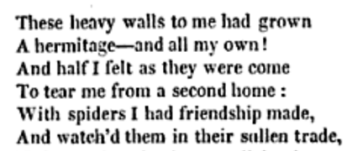
Byron, “The Prisoner of Chillon”
…but probably not. More likely it is a sort of back-formation from “depression”–as in economic depression–which many think of now as a psychological metaphor for the economy, rather than a literal synonym for a “lowering” of trade. The word’s psychological meaning is preobably the biggest association it now has, after all, besides the capital-D Depression. Note, again, all the economic metaphors that draw on individual bodies and psyches, despite economists’ pretensions to dispassionate empiricism–“vigorous” and “robust” markets, “markets” that react to the news calmly, pessimistically, or my favorite, “skittishly,” as if the markets are irrational paranoiacs or stupid dogs barking at a thunderstorm.
But economic slumps were called “depressions” because they were a “lowering in quality, vigour, or amount” of trade, not because the economy was depressed, like a person might be. The job market becomes “sullen” because it seems sluggish and obstinate, and needs to perk up and figuratively clean its room–a “sullen” economy isn’t nearly as serious as a “depressed” one. But this distinction gets at one of the defining characteristics of the moralism of austerity: economic (and other kinds of) depression is not only apolitical, it is a moral failing of those who suffer from it. A “sullen economy,” and those just entering it, just need to cheer the hell up.
Have a Very Austere #Christmas, from the Keywords Family to Yours

As the year ends and we prepare to celebrate the miraculous disruption of non-virgin births that took place so long ago in Bethlehem, let’s take a look at a couple ways that others have innovated Christmas.
One of the earliest commercial uses of “innovation” I’ve found comes from this ad for the old Gimbel’s Department Store in New York, which advertised a model of wardrobe trunk called the “Innovation.”

Below the attractive trademarked logo, the ad copy reads:
Here is one of the most practical and welcome INNOVATIONS in Gift Giving that many years have produced. Nothing could be more practical than one of these splendid Trunks–known all over the world for their strength, roomy construction, convenience, beautiful finish and appearance. How DELIGHTED any one would be to receive an INNOVATION Trunk on Christmas Morning!
Three decades later, there was the foreman of Santa’s ceaseless Fordist production line, giving a master class on how to motivate an employee who doesn’t buy-in to your firm’s spirit of collaboration:
“Don’t want to make toys? Get back to work!”
More recently, there’s this “smart” set of Christmas lights that lets you turn on your Christmas lights via Twitter, allowing not only you, but anyone with your Twitter account, to manipulate your Christmas tree remotely. “The goal of the project,” according to this NPR report, “evokes an odd combination of world domination and holiday cheer,” which they say like it’s a bad thing.
But the real innovator of Christmas lighting was Thomas Edison. Here’s his great grand-niece, Sarah Miller Caldicott, who took to Forbes.com to regale us with the story of old man Edison’s “disruption” of the stodgy old Christmas candle industry one magical evening in 1879, when he provided “tech and awe” to the gathered multitudes:
While it’s been nearly 135 years since crowds first thronged to witness Edison’s electrical conjurings, we’re still drawn like fireflies to the “tech and awe” of disruptive innovation. Technological breakthroughs strike a universal chord of inspiration and delight within us.
Although Miller notes that lit candles continued to dominate home Christmas displays until well into the 20th century, that’s just a quibble. The main point, here, is her use of the deadly aerial bombardment of Baghdad–“shock and awe,” as it was called in 2004–an an analogy for the magic of Christmas, and for “disruptive innovation” in general.
Happy holidays!
Keywords for the Age of Austerity 23.5 “Free speech”
In the swift backlash against the inspiring victories that students at Mizzou have won against a hostile administration and a culture of institutionalized racism there, the rebellious students are now being charged in some circles as the real authoritarians–fragile, intolerant, determined to score victories against phantoms of their own creation. The right-wing version of this backlash reached an asinine nadir in USA Today when University of Tennessee law scholar Glenn Reynolds called for college students to be barred from voting, since “the 18-year-olds of today aren’t up to [the] task” of having “adult political discussions.” (the article in a nutshell: Students who don’t tolerate disagreement should be disenfranchised if they disagree with Glenn Reynolds). Less absurdly, though with enough finger-wagging of his own, Conor Friedersdorf in the Atlantic weighs in on student activists at Yale who, he’s quite sure, “will look back on their behavior with chagrin.” Friedersdorf’s rather TL;DR article opens itself to various critiques–one of them is its treatment of Yale as on the one hand a litmus test of American higher ed, and on the other a place of special concern because it is where our “elites” are acculturated.
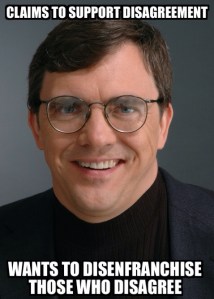
Another problem is its misunderstanding of what it takes to be its central principle, that of “free speech.” As I wrote in Keywords for the Age of Austerity #6: The Conversation, many uses of free speech–like its ideological cousins “dialogue” and “civility“–treat is as the tone and tenor of communication, rather than the structural means of communication. Friedersdorf complains of young activists’ “illiberal streak” and their tendency to “lash out” in anger and rage, instead of disagreeing with “civility” and a “measured” tone. One irony is that Friedersdorf criticizes students who demand “safe spaces” as intolerant of discomfort while holding them responsible for making others uncomfortable. How can we hold simultaneously to a view of free speech as the circulation of disagreement while denouncing communication whose tone is disagreeable?
Part of the problem is the phrase itself–“freedom of speech” is a metaphorical phrase, which encodes the political relation between subjects and authorities as a face-to-face, peer-to-peer conversation. (Friedersdorf goes into great detail, in fact, about a student shouting in the face of a Yale administrator.) Hence liberal free-speech scolds’ obsession with tone and their indifference to power. The other problem relates to this last–students, it seems, should tolerate and embrace “discomfort,” while their authority figures–deans, professors, parents–should not. In the New Yorker, Jelani Cobb has eloquently summed this up as the “free speech diversion,” a kind of sanctimonious performance of concern that dodges what should be the central concern at Yale and Missouri, student disempowerment and cultures of racism, by invoking
a separate principle, one with which few would disagree in the abstract—free speech, respectful participation in class—as the counterpoint to the violation of principles relating to civil rights. This is victim-blaming with a software update, with less interest in the kind of character assassination we saw deployed against Trayvon Martin and Michael Brown than in creating a seemingly right-minded position that serves the same effect.
In other cases, it is simply unclear what, if anything, “free speech” means. In today’s New York Times, Suzanne Nossel of the PEN Center warns that free speech is under attack, but “not from our government or corporations, but from our citizenry. Pitched battles being waged at Yale and the University of Missouri pit speech versus speech in a contest of who and what is entitled to be heard.” “Speech versus speech,” duking it out in some kind of bullring, is an awkward, weird phrase that treats “speech” as if it is not just a voice in an egalitarian conversation, but a being all its own. The awkwardness speaks to the deeper confusion in the essay. It’s not at all clear what “free speech” means in Nossel’s usage until we get to the end: it is “the marketplace of ideas,” where “speech” engages “speech” on terms of equality and civility, and may the best argument win. (As many have pointed out, using the “marketplace” as a metaphor for equality is itself nonsensical).
But student activists well know that this is not how campus politics, or politics anywhere, works. If campuses are a marketplace, they are in the more literal sense: unequal and uneven, where access and amplification depend on your wealth and status. Where something is sold and something, or someone, is bought.
Which brings us to the modern origins of “free speech” as a campus virtue in the first place. Mario Savio’s speech on the Sproul Hall steps in Berkeley in 1964 discussed “free speech” in terms that have barely any relation to the fantasy idea of civility with which it has since been corrupted. Savio’s speech is famous for his description of civil disobedience–the practice of free speech– as “putting your body on the gears” of the machine of an unjust system. It is important to note that in the moments just before that oft-quoted passage, Savio begins by denouncing a version of the university that many of us assume is new or unique to our times–that it is structured like a business and run like one, in which the only ideas of value are those that have “value” to private industry or the military. For Savio, free speech is not about having conversations with campus leaders, but winning the freedom to challenge them. And, if necessary, to prevent “the machine from working at all.”
“We have an autocracy here,” says Savio. He goes on, describing the Berkeley president derisively as a “well-meaning liberal.”
We were told the following: If President Kerr actually tried to get something more liberal out of the Regents in his telephone conversation, why didn’t he make some public statement to that effect? And the answer we received–from a well-meaning liberal–was the following. He said, “Would you ever imagine the manager of a firm making a statement publicly in opposition to his Board of Directors?” That’s the answer.
Well I ask you to consider — if this is a firm, and if the Board of Regents are the Board of Directors, and if President Kerr in fact is the manager, then I tell you something — the faculty are a bunch of employees and we’re the raw material! But we’re a bunch of raw materials that don’t mean to be — have any process upon us. Don’t mean to be made into any product! Don’t mean — Don’t mean to end up being bought by some clients of the University, be they the government, be they industry, be they organized labor, be they anyone! We’re human beings!
Savio is shouting, most disagreeably, at this point. He should’ve never been allowed to vote.
Entrepreneurs, Entrepreneurs, Entrepreneurs: Rick Scott’s letter to Florida’s University Faculty

In a recent 320-word letter to Florida’s university faculty (14 of which were variants on “jobs” or “entrepreneur”) Governor Rick Scott thanked professors for “helping Florida’s students earn degrees that prepare them for jobs and”–lest you think he is some kinda philistine–“the opportunity to lead fulfilling lives.”
The major point of the letter, though, was to solicit nominations for something called the “Young Entrepreneur Award.” After mentioning his signature initiatives to rein in college costs–one of which was the laughably paltry one-year moratorium on sales taxes for textbooks–he put the onus back on the students.
As a student, I worked to pay my way through college, and I am sure you have many students who are doing the same. I recently created the Young Entrepreneur Award to recognize Florida students, college graduates, and young entrepreneurs who are excelling in the workplace and creating innovative ideas here in Florida. I encourage you to nominate your entrepreneurial students and recent graduates for this award to help get all of your students thinking about their future jobs.
Especially given the implicit accusation in that first clause–I paid my way through college, so why don’t you?–Scott’s request offers a textbook example of the moralism implicit in the word “entrepreneur.” Self-reliant entrepreneurs conquer hardships through hard work and creativity, this thinking goes, earning their success, instead of depending on others–which becomes, in turn, a kind of weakness.
In the context of state cuts to higher ed and tuition hikes, Scott’s pivot from state government funding to student entrepreneurship is a good example of what Wendy Brown calls “responsibilization” in neoliberal politics. Students re-imagined solely as future job-havers become stakeholders, investing in themselves as future earners; public funding for colleges is merely an investment in future income tax revenue; citizens entitled to education as a right are reduced to “taxpayers” funding it. As Brown writes in Undoing the Demos, “Responsibilized individuals are required to provide for themselves in the context of powers and contingencies radically limiting their ability to do so” (134). This language of responsibilization, she argues, deprives citizens of power while also disavowing its own. It is not your university administrators and political leaders who are responsible for the cost of your education, it is you–if you can’t afford it, work longer, innovate better, excel harder, be more entrepreneurial as you attempt to work, study, and live every other part of your life.
Pudd’nhead Wilson meets Jose Bautista
He was writing about the F.F.V.–the First Families of Virginia, the elite caste of slave-owning aristocracy–but Mark Twain might have been channeling a lousy sportswriter, a old-school bench coach, or Sam Dyson, the Texas Rangers’ relief pitcher who last week gave up a series-clinching home run to José Bautista and then told him to “respect the game.” The Toronto Blue Jays’ Dominican outfielder walloped a three-run homer and flipped his bat in celebration, a violation of baseball’s “unwritten rules” against showboating. In his 1892 classic Pudd’nhead Wilson, Twain wrote that the F.F.V.
had its unwritten laws, and they were as clearly defined and as strict as any that could be found among the printed statues of the land. The F.F.V. was born a gentleman; his highest duty in life was to watch over that great inheritance and keep it unsmirched. He must keep his honor spotless. Those laws were his chart; his course was marked out on it; if he swerved from it by so much as half a point of the compass, it meant shipwreck to his honor; that is to say, degradation from his rank as a gentleman. These laws required certain things of him which his religion might forbid: then his religion must yield — the laws could not be relaxed to accommodate religions or anything else. Honor stood first; and the laws defined what it was and wherein it differed in certain details from honor as defined by church creeds and by the social laws and customs of some of the minor divisions of the globe that had got crowded out when the sacred boundaries of Virginia were staked out.
The novel’s leading F.F.V., Judge Driscoll–slaveowner, first-class citizen–flies into a rage when his nephew, Tom, is kicked in the behind in public and reports the crime to the authorities. The Judge flies into a rage: “You cur! You scum! You vermin! Do you mean to tell me that blood of my race has suffered a blow and crawled to a court of law about it?” The “honorable” thing to do, the Judge explains, is to challenge the kicker to a duel–to shoot him dead in the street. This is the point, after all, of “unwritten rules,” to legitimize unjust hierarchies and cruel treatment by shrouding them in “tradition.” It’s not about the enforcement–Judge Driscoll, after all, controls his town’s written rules also. It’s about the broader power that comes from knowing the “unwritten rules” in the first place, and making sure everyone else knows that you know.

Baseball’s “unwritten laws” are often described as “arcane,” a “canon” governed by tradition. (They are also a favorite target of sportswriters who love to be exasperated at them). As far as I can tell, they’re not too complex–not writing the rules down seems to prevent everyone from noticing how dull and stupid they are. Don’t watch a home run; don’t jog to first base; don’t call attention to yourself by celebrating outside the dugout; only acknowledge the crowd on the rare occasions when they ask for a curtain call. Otherwise, we can throw a baseball at you. Simple as they are, they’re also inconsistent. For example, if you are a pitcher, you may do many of these things with impunity, a point made by Carlos Gómez, a Dominican star for the Houston Astros and a persistent “unwritten rule” violator.
The racial, ethnic, and national politics of baseball’s code of honor were documented in an interesting recent investigation published in USA Today. Of the 67 bench-clearing incidents in Major League Baseball over the past five seasons, a little more than half “pitted white Americans against foreign-born Latinos,” wrote Jorge Ortiz, the author of the report. “Another four featured white Americans and U.S.-born Latinos.”

Gómez called the restrictions on celebration “rules from a different time.” Bautista, in his comments about the wild 7th inning of the Blue Jays’ playoff victory against the Rangers, mentioned different places. Had he ever seen anything like it–benches clearing, unruly fans pelting the field with beer cans and debris? “Not in the big league level, not in the U.S.,” said Bautista, who plays with Licey in the D.R.’s national league. He was speaking, of course, in Canada, not the U.S., but he was referring to the relatively buttoned-up rules of the American league. I’m not sure what the Dominican league is like, but when Toronto fans pelted the field in anger after an umpiring decision that went against the home team, it reminded me of games at Caracas’ Estadio Universitario, where I used to attend Leones de Caracas games regularly. The tickets were cheap and the quality of play high, so I used to buy seats I would never be able to afford in a major-league stadium–in the lower deck, near the dugouts. As I discovered, these are also seats likely to be soaked by beer thrown from the higher seats, often tossed in celebration after a home run by the home team. (To be clear, the beer wasn’t thrown on the field, just on the other spectators). For big games, I learned not to wear anything I didn’t want to get beer on. Leones games against Navegantes de Magallanes–the Venezuelan equivalent of the high-stakes Red Sox-Yankees series of a few years back–were enthusiastic, loud, but with an almost political intensity that I associate with European soccer matches, an intensity that could be thrilling and a little intimidating.
In U.S. stadiums, by contrast, a stiff formality still prevails, part of baseball’s commercial commitment to entertainment and “family friendliness” but also the sign of the national pastime’s hoary notions of tradition and history. One of the jokes of Twain’s novel, though, is that the people who crow the loudest about “honor” and “tradition” are usually covering for their own mendacity or mediocrity. Curt Schilling, incompetent swinder and Donald Trump superfan, said with apparent approval that Bautista should be ready to get hit next season in Texas. And here is Bud Norris (2015 ERA: 6.72), talking after a game in the long-time northern Mexican city of San Diego, where he plays for a team called the Padres, standing up for the “honor” of the game against the “antics” of certain players. “If you’re going to come into our country and make our American dollars,” he said, “you need to respect a game that has been here for over a hundred years.”
 Unwritten rules are all about the defense of unearned, inherited privileges. And the ethnic and racial meanings of baseball’s unwritten rules are never far from the surface.It’s only appropriate that the sport that calls itself “America’s pastime” is also its most sanctimoniously, obliviously innocent about this.
It was nicely ironic that the Texas Rangers–a baseball team named after a racist paramilitary organization founded to terrorize Tejanos–were victimized by Bautista and his bat flip. If you’re a baseball fan, it’s a good sign that the loudest calls for Bautista to “respect” the game seemed to come from the likes of Schilling and Dyson, the sore loser. Someone buy Dyson a beer, and pour it on his head.
 Keywords: The New Language of Capitalism