Keywords for the Age of Austerity 20: Pivot

In the first season of Silicon Valley, the HBO sitcom that poked (gentle, but often hilarious) fun at tech-industry and creative-class myth-making, the vest-wearing, number-crunching technocrat Jared is kidnapped by a malfunctioning self-driving car belonging to the show’s tech mogul villain. Jared eventually escapes and makes it home in the midst of a crisis for his startup, Pied Piper. Sleep deprived and manic, he sets out to save the company with a “pivot.” He reassures his colleagues that many successful companies rebranded themselves early on in order to survive: Chatroulette, he explains, began as a social media platform but then pivoted to “become a playground for the sexually monstrous.”

As Jared explains, the basic technology his group has developed will remain the same–the “pivot” only changes how they market it to outsiders. As Jared’s suggestions become increasingly flat-footed and desperate, we see that the normally straight-laced numbers man is so traumatized by his desperation to “pivot” that he becomes nearly monstrous himself: he has no interest in what Pied Piper develops, as long as it develops anything marketable (aps for rat-detection and child-stalking are two of his ideas).

The season ultimately ends with a conventional tribute to to “going your own way,” as the coder-heroes innovate their way out of their dilemma by improving their original product. Nevertheless, the episode satirizes “pivoting’s” pretensions to both corporate “agility” and statesman-like strength–see, for an especially tedious example of the former, the Obama “pivot to Asia.” (The irony was lost on some writers who read Silicon Valley as an ode to “pivoting,” which is the power of “creative thinking, flexibility and perspective. Essentially, when life gives you lemons, just pivot.”)

The “pivot” contains a conflict inherent in many of the keywords for the age of austerity, which celebrate 1) zealous moral commitment (the Way of the Entrepreneur) and 2) acquiescent flexibility to the demands of the market (the “nimble” organization that turns on a dime, or in response to a trend). This may not be a contradiction for those for whom “the market” is an omnipresent, eternal force, a mystical object of entrepeneurial devotion, rather than a political instrument and historical notion. So in so many of the keywords I have examined thus far, the training of one’s entrepreneurial attitudes goes hand-in-hand with the shaping of one’s body by the disciplining austerity of the marketplace.

For anyone else, the proliferation of bodily metaphors in economic writing—nimble, agile, flexible, robust, even “austerity” itself–reveals both the naturalization of market logic, which is in our very bones and muscles, but also, sometimes, the cruelty it can inflict on those who labor. As I wrote in the entry on “flexibility,” workers exhorted to be more “flexible” are required to stretch themselves further and further, sacrificing their family life, health, and happiness for their job. “Pivot” is a peculiar example of economic body talk because it is the most nonsensical: we can see why a corporation or an employee fearful of layoffs might want to be “nimble,” leaping and springing gymnastically to meet every need, but pivoting is all about constraints on movement. A person “pivots” by moving right or left while they remain stationary; in basketball, of course, you can’t move the “pivot foot” after you pick up your dribble. A second baseman turns a double play by pivoting from his right to his left without leaving the base. Alternatively, the pivot is, as the OED says, “any physical part on which another part turns”–a tool in the manipulation of some larger object. This is how the word used to be used metaphorically, in political journalism that referred to various countries as strategic “pivots.” Taiwan and Japan, for example, were often described as “pivots” in Cold War Asia. (Are “pivots” always in Asia? Or only on islands, like Cuba, site of Obama’s newest pivot?). Political parties could also occupy a pivot position, exerting leverage one way or another, as when a 1967 New York Times report on the French elections described the Socialists as a pivot between left and right parties. This is more in line with the conventional definition of “pivoting” as stationary movement, which provides leverage for shifting direction one way or another.

Until the late 1990s, “pivots” were, like “nimble,” mostly found in the sports section. Screen shot 2015-07-06 at 10.58.09 AMIts recent explosion in political journalism is seemingly borrowed from business jargon, where as Jared shows it translates roughly as a “rebranding.” In its political lobbying, the Catholic Church is said to “pivot” from “social issues” to inequality and the environment. Eastern Europe, wrote Frank Bruni in 2003, “pivoted” in a secular direction after 1989. In 1999, Bruni–he appears to be a pioneer here–used it to refer to political candidates’ practiced, canned redirection of journalists’ questions. “Mr. Hatch can pivot from just about any subject to a pitch for his campaign’s Internet site,” Bruni wrote. Here, one “pivots” from one question to another if you can’t answer the first one. I suspect political journalists like the word as much as they do because it calls attention to the rhetorical dancing politicians do to flatter journalists.
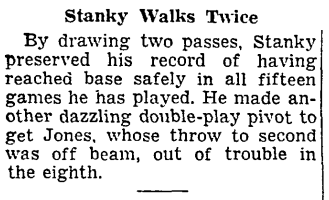
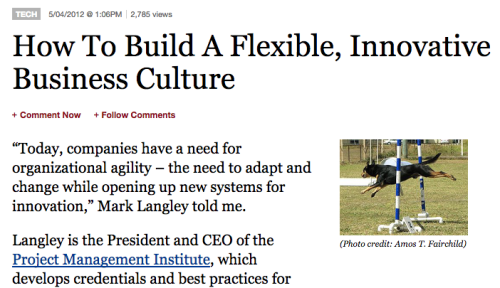
So “pivots,” being essentially media exercises, are inherently superficial and highly personalized forms of accounting for complex economic and political processes. My favorite case in point comes from Fast Company, which never met a superficial category that it didn’t love and therefore has a whole column called “The Pivot.” Detroit’s bankruptcy, it turns out, was a “pivot.” (Snoop Dogg’s transformation into Snoop Lion? A pivot. Obama’s 2012 reelection as president, er, “Pivoter-in-Chief?” You guessed it. The column writes itself.)

The tech world has a word for Detroit‘s bankruptcy filing yesterday, and it’s not fiasco, fatal, or doomsday. It’s pivot. If something fundamental isn’t working—the business model, the core technology—you make a dramatic change, despite the risk and short-term pain. It’s a gambit for the long-term survival of the enterprise.

The article is a particularly tone deaf but not exceptional account of the bankruptcy as a clean start, a clearing of accounts and a break from older “mismanagement” and “corruption” (why a municipal bankruptcy overseen by banks and political appointees would be logically more competent and less corrupt than normal city business is never explained). Many “serious” journalists described the bankruptcy in this basically moralistic way, perhaps because the actual legal process was too byzantine to assess it any other waygiphy.

The Fast Company author’s examples–a few entrepreneur profiles, some Dan Gilbert puffery, etc.–are par for the course. The “pivot,” which claims to be so substantial, is really just a clumsy illusion: turning around in a circle, shouting “Ta-da!” and hoping nobody notices.
Keywords for the Age of Austerity 19: Resilience

Resilience, n., “Elasticity; the power of resuming an original shape or position after compression, bending, etc.”

“The quality or fact of being able to recover quickly or easily from, or resist being affected by, a misfortune, shock, illness, etc.; robustness; adaptability.”

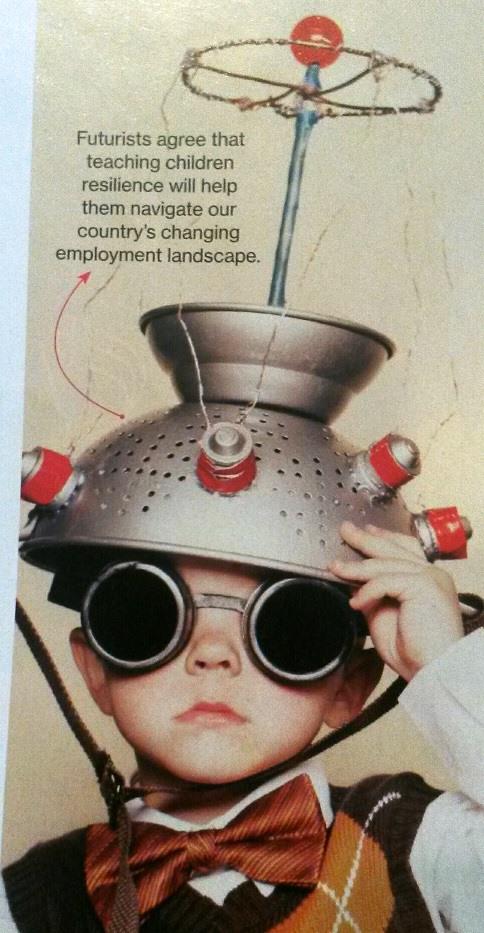
“Resilience” is everywhere, its popularity rising proportionally with the dangers, or perceptions of dangers, facing the planet: climate change, food shortages, financial crisis, or for the Wall Street journal crowd, strikes (also fire and hurricanes). The definitions of the currently voguish term differ, but most trace its origin to C.S. Holling, an environmental scientist who defined it as “a measure of the persistence of systems and of their ability to absorb change and disturbance and still maintain the same relationships between populations.” The field Holling pioneered, “ecological economics,” applied this concept to the management of natural resources, especially in the third world, which has made “resilience” part of the rhetorical arsenal of “sustainable development.”

It is also common in the language of humanitarian relief, where a people’s “resilience to crisis” is thought to be proactive preparation for disaster, rather than a reactive response to it. Note the grammatical strangeness of this neological construction, as if “resilience to” is literally replacing “resistance to.” While there may indeed be practical benefits to planning in this way, the problem, as Julian Reid and Brad Evans write in their excellent new book Resilient Life: The Art of Living Dangerously, is that we apply the word “resilient” to a population “insofar as it adapts to rather than resists the conditions of its suffering in the world.”

“Resilience” is a mainstay of pseudo-scientific self-help literature that drives the “wellness” and “mindfulness” industry, in which one’s physical and spiritual health is defined in terms of one’s ability to “bounce back” from hardship. This assumes three things: as we saw with “wellness,” health becomes the individual’s personal responsibility, and poor health his own failure; it is a receding horizon, since one can always be more well or more resilient; thirdly, it presumes catastrophe and crisis to be baseline conditions of everyday existence without questioning why this is, or whether it should be.

Finally, “resilience” has been taken up enthusiastically by the purveyors of click-baity executive pablum in places like Fast Company and Harvard Business Review, which produce endless lists of the 5, 10, or 7 habits of “resilient” executives, employees, or companies. “Why do some people and some companies buckle under pressure?” asks HBR in one such article. “And what makes others bend and ultimately bounce back?” The unstated implication is that some entrepreneurs, we won’t say who, just wet the bed under pressure. Don’t be one of those.

resilient
New Orleans after Katrina, ca. 2005

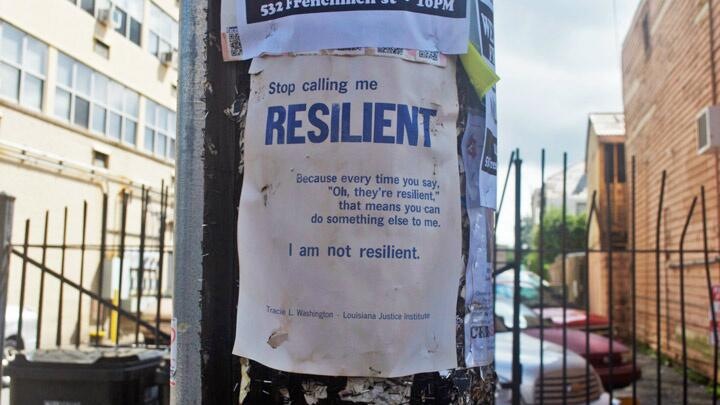
In humanitarian and development discourse, resilience talk often reads as a form of sympathizing with a local, usually impoverished population and praising their strength in the face of hardship. Such professions of sympathy, however sincere or well intentioned, can quickly become powerfully cynical if they do not consider history, power, and the distance between the “resilient” subject and the person or institution calling them such. This is the point of a much-circulated poster in post-Katrina New Orleans, which bore a quotation attributed to a local lawyer, Tracie Washington: “Every time you say, ‘Oh, they’re so resilient,’ that means you can do something else to me.”

from the New Orleans blog catfishforlunch.wordpress.com
from catfishforlunch.wordpress.com

“Resilience” becomes a way of assessing the post-disaster situation sociologically without treating it politically. Haitians have also endured much of this faint praise. The USAID called Haitians “the most resilient people on earth” after the 2010 earthquake, which seems like a vague allusion not just to the disaster response but to the country’s longer history of oppression and resistance that we vaguely know but which cannot be named. Swap “resilient” for “oppressed” or “revolutionary,” though, and you would have quite a different USAID press release.

The heroic narrative of Black sufferers that endure cruelty and misfortune with stoic resolve has, of course, a long history. In “Many Thousands Gone,” James Baldwin referred to Aunt Jemima and Uncle Tom, those depthless objects of white affection, as “prodigies of resilience,” preternaturally gifted with the power to endure pain. Despite its scientific origins, many common uses of resilience are quite sentimental, partly because they seem to tell us more about the speaker of the praise, rather than its object. This praise is also empty, coming as it does without distinction–we are hard-pressed to name the country that responded to a devastating hurricane or earthquake unresiliently.

Given its slippery usage, it is perhaps appropriate that the word’s Latin root is resilientia, or “fact of avoiding.” Its earliest meaning comes from engineering, where it refers to the flexibility or elasticity of an object. Only later was it applied figuratively by Holling to an ecosystems’ capacity to absorb change: the currently voguish appropriations of “resilience” are therefore metaphors for a metaphor: “resilient” people borrow the capacities of ecosystems to recover from crisis, and this ecological meaning was in turn borrowed from an object’s ability to bend. What is often lost along the way is Holling’s rather limited application: a “resilient” biological system does not “adapt” (he gave this term a different meaning, even though the OED uses it as a synonym), nor does it “bounce back,” as a ball springing off a “resilient” object would,or recover its original state, as a “resilient” piece of putty might: it simply persists in an altered but basically intact state. It doesn’t break, but this doesn’t mean it is not damaged.

The bestselling book Resilience: Why Things Bounce Back, which received the imprimatur of the New York Times op-ed page, shows how elastic the term can be. Although their subtitle defines resilience as “bouncing back,” authors Andrew Zolli and Ann Marie Healy define the term more narrowly as “the capacity of a system, enterprise, or a person to maintain its core purpose and integrity in the face of dramatically changed circumstances,” which also confuses three categories–complex “systems” (whether economic or political), private businesses, and individuals–often better thought of as antagonists.

Their opening anecdote, the Mexico City tortilla riots of 2007, is telling as an example of the present sense of crisis that motivates “resilience” talk, and of its acquiescence to that crisis. As Zolli and Healy write, theMexico City demonstrations erupted after world corn prices skyrocketed, drastically increasing the local price of tortillas. Although they recognize the role of U.S. corn subsidies and ethanol production in inflating corn prices, the authors attribute the riots to Hurricane Katrina–a “natural” disaster–which damaged oil refineries and encouraged the planting of more ethanol corn. Zolli and Healey also acknowledge how NAFTA has allowed U.S. corn to dump their product on Mexico, but oddly, these causes are treated not as political circumstances but as metaphorical hurricanes: since “we cannot control the volatile tides of change,” they write, “we can learn to build bigger boats.”

Okay, so the word “resilience” takes its urgency from global destitution, hunger, and a forthcoming environmental cataclysm, but damn it, what’s the good news? “The good news,” an enthusiastic Forbes contributor writes, “is that everyone can learn the habits of mind that can better prepare themselves and their institutions for unanticipated change and become more prosperous, safe, and happy in the process.”

Screen Shot 2015-06-23 at 12.44.27 PM

The Mexico City example reminds me of something George W. Bush’s Ambassador to Ecuador told a group of Fulbright fellows I was a part of sometime in 2006. Those of us on fellowships in the Andean countries were in Quito for a conference, which featured a Q & A with the Ambassador. That week, the Bush administration was negotiating a free-trade agreement that would require the Ecuadorean government to cut subsidies on its domestic corn, naturally without requiring Washington to do the same. (Large-scale protests planned for the coming days would eventually scuttle the deal.) One of our group–as I recall, an agronomist working with campesinos in rural Ecuador–asked the Ambassador what she should tell the farmers in the district where she was living, where people had been harvesting corn for generations, probably since pre-Columbian times. The Ambassador’s response, whose arrogance actually shocked me at the time: “I would tell them to grow broccoli.”

She was imploring these farmers to become more “flexible,” in other words, lest they be driven off their land into the overcrowded slum cities–where they would then be required to get “resilient,” and in a hurry. The resilience metaphor borrows from the engineering the concept of elasticity or flexibility–the ability to respond “nimbly” to external shocks. As Alan Greenspan said in a 2004 speech, “the increased flexibility of our labor market is now judged [by whom?] an important contributor to economic resilience,” and the IMF agrees that the most “resilient” economies have the most “flexible” labor and commodity markets.

These example are of course part of a long tradition of naturalizing our contemporary political and economic order, treating food shortages and layoffs as if they are acts of nature. We can see endless examples of this in entrepreneurial discourse: see the talk about “innovation ecosystems” and “innovation energy,” in which innovation pseudo-science verges on New Age nature-worship (“You can just feel the innovation energy at this Chinese-government funded Microsoft technology campus, man.”) But as Evans and Reid write in their book, it also a measure of the absorption of sustainable development’s original ecological critique of capitalism: innovation “ecosystems” now help to provide the “balance” that environmental restrictions were supposed to ensure.

Resilience began to be conceived not simply as an inherent property of the biosphere, in need of protection from the economic development of humanity, but a property within human populations that now needed promoting to the increase of their ‘economic options.’ Remarkably, then, the biosphere itself began to be conceived not as an external economic domain…but an economy of ‘services’ which humanity receives.

Resilience, once a property of the environment, becomes a property of people; at the same time, wealth is a property of the environment, while its costs are borne by the people who work it. Those most vulnerable to the environmental shocks associated with modern capitalism are also the ones charged with becoming more “resilient” against them. As a New Orleans blog, Catfish for Lunch, puts it more bluntly: “When we celebrate resilience, we focus the spotlight on the people who got screwed over. The institutions that did the screwing over take the opportunity to slink off into the shadows.”

From the mailbag: “best practices”

Another good idea from the Austerity mailbag: “Thanks so much for this series. I would love to see “best practices” ruthlessly analyzed because it seems so hard to argue against “best practices.”  Who would argue against the concept?  Someone who is okay with only “good practices” or even “worst practices”

Keywords for the Age of Austerity 18: Descending into Violence

This keyword entry is an unusual one, since it doesn’t have the same business-world origins of most of our others. As a feature of post-1990s coverage of first-world political dissent, however, it fits our timeline. 

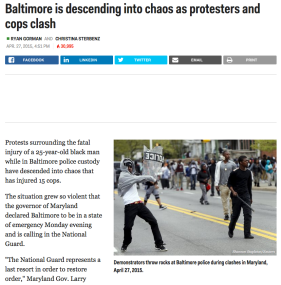
If you read any coverage of the Baltimore “riots,” you will read that formerly peaceful protests “descended into violence.” This cliché was inescapable in reporting on the Baltimore protests, as Sarah Jaffe observed on Twitter. It’s a standby of reporting on urban demonstrations in Charm City (a Baltimore Sun headline this week announced that protests “descended into chaos”) and around the world. Anti-austerity demonstrations “descend into violence,” the London Independent headline reported in 2011; after 8 Palestinians were shot dead at a Gaza demonstration in 1998, an Israeli defense minister told Toronto’s Globe and Mail in 1998 that he was “very concerned” that the Palestinians allowed things to “descend into violence.”

Screen shot 2015-04-30 at 9.56.47 PM
Business Insider, 4/27/15

It’s a standby in war reporting, as well: The Economist reported, preposterously, that “fears are growing that Iraq may descend into violence as American troops leave” in December 2011, by which point many thousands had already perished during the Iraq War. In U.S. and UK media, it’s a phrase that links together all the violent trouble spots of recent world history in a sad fraternity: Afghanistan, Yugoslavia, Cambodia, Argentina, Northern Ireland, Mexico, East Timor, and South Africa have all “descended into violence” at some point. George Shultz, Ronald Reagan’s secretary of state, warned “black South Africans” to avoid an “easy descent into violence, terrorism and extremism” by seeking compromise with the apartheid government. If there is a place in the world that is already spectacularly violent, there is undoubtedly a reporter or official wringing his hands about its “descent into violence.”

As my colleagues Tracy Neumann and Quinn Slobodian have pointed out, “descents into violence” also frame retrospective accounts of 1960s activism in the United States and Europe. Here, the virtuous early 60s of non-violent protest and civil disobedience (the March on Washington did not “descend into violence,” noted CNN with approval) are distinguished from the “bad 60s” of rage and disorder (see the West German Baader-Meinhoff group’s “descent into violence”; when was this armed leftist organization anything but?) Finally, it comes up in the odd report on the murderous pathology of an individual criminal: “Killing of Cats Called Warning of Descent into Violence,” the Buffalo News reported in July 1998.

The phrase goes back in foreign policy reporting to at least the 1980s, but it’s typically been reserved for the “underdeveloped” world and its supposedly retrograde (hence “descent,” a movement backwards or beneath) predilection for disorder and revolt. The earliest use of the phrase that I could find to describe protest movements in the United States and western Europe is surprisingly recent: The Times of London ran a headline, “March against Le Pen Descends into Violence,” a report on a French march against the far-right politician Jean-Marie Le Pen, on March 31, 1997.

Perhaps the phrase comes into such prominence at the end of the 1990s because this is the beginning of an era of mass mobilizations in Europe and the United States (against globalization, neo-fascism as in the Le Pen case, austerity, and most recently, police killing).

Furthermore, these movements are shadowed, especially in the United States, by the sanitized myth of Martin Luther King, Jr. and the “respectful” civil rights movement that has become so dominant. Here, what King called “nonviolent direct action” becomes “peaceful protest,” which it decidedly wasn’t–if by “peace” we mean the public order and complacency that direct action is determined to upset.

Screen shot 2015-04-30 at 10.05.10 PM
New York Times, 2/9/64

News coverage of riots and demonstrations from the 1960s is full of ominous warnings about “violence,” but there it is accepted as the expected order of militant protests, rather than a deviation from a respectable norm. A Feb. 9, 1964 New York Times article warning of rising racial tensions warned that “the carefully scrubbed, neatly dressed college students who sat down at lunch counters across the South in 1960 and politely ordered coffee are gone for the most part.” 4 years later, the Times ran this lede to a report buried deep on an inside page, so unexceptional was it in October 1968: “Angry Negroes poured into the main business street of Washington’s northwest Negro district tonight in a brief but violent protest over the fatal shooting of a Negro man by a white policeman.” Martin Luther King, Jr. was barely in the ground; his legacy of non-violent resistance hadn’t had time to be looted by the cynics today disguising their passivity by lamentations for “violence.”

Screen shot 2015-04-30 at 11.00.34 AM
New York Times, 10/9/68

“Descending into violence” thus rests on two words that cry out for explanation: what is “violence,” and if we’re descending into it, what are we descending from?

The imbecilic Wolf Blitzer was one of those who invoked King on CNN to demand that Deray McKesson, a prominent activist in Ferguson, repudiate the “violent” Baltimore protests. Put aside the obvious fact that if not for the “violence” he so deplores, Blitzer wouldn’t be talking about Baltimore in the first place. McKesson’s admirable, frustrated response derived from Blitzer’s inability to recognize the difference between the “violence” visited upon Freddie Gray’s spine and that dealt upon a store window. “Violence,” the Baltimore Sun’s headline suggests, is equivalent to “disorder,” “chaos,” and “looting”–anything that upsets the “peace” of the city’s normal business. Likewise, Blitzer seems to regard “violence” as, essentially, breaking anything; it matters not whether that thing is a body or a piece of property.

The Sun’s headline contained something revealing, meant to be excerpted for readers to share on Twitter: “Baltimore devolves into chaos, violence, looting.” This is where the use of the “descent into violence” for both third-world “troubles” and pathological murderers becomes relevant: the city Freddie Gray lived in had fully descended into “violence” once his spine broke. What makes what came after a “devolution” is the race of the protestors, and the pathological violence with which they are associated by a racist media.

Screen shot 2015-04-30 at 10.10.50 PM
Baltimore Sun, 4/28/15

And here, it is worth pointing out that of the words commonly used to delegitimize political uprisings, two–“loot” and “thug”–entered the English language via the British empire. “Thug” was an English slur for an Indian criminal, derived from the Hindi for “swindler”. As James Hevia writes in English Lessons: The Pedagogy of Imperialism in Nineteenth Century China, “loot” replaced earlier terms like “pillage” and “plunder,” evoking “a sense of the opportunities, particularly as ‘prize’ of war that empire building offered to the brave and daring.”

To loot, if you were an imperialist, was to bravely plunder; if you are one of the plundered, however, it marks you as a “thug,” already descended into unredeemable violence.

Keywords for the Age of Austerity 1: Innovation


“Keywords for the Age of Austerity” is an occasional series on the  vocabulary of inequality. Certain words, as Raymond Williams wrote in his classic Keywords, bind together ways of seeing culture and society. These shared meanings change over time, shaping and reflecting the society in which they are made. Some of the words I will consider here are old, seemingly innocent terms that have acquired a particular fashion or developed a particular new meaning in recent years; others are recent coinages. All of them relate to to an affinity for hierarchy and a celebration of the virtues of the marketplace, of competition, and of the virtual technologies of our time. This series will explore the historical meanings embedded in these words as well as the new meanings that our age has given them.

Care to suggest a word? Send me a message or a tweet at me.

This is the first entry, on the modern virtue of innovation.

Innovation (n); innovate (v., trans. or intrans.); innovative (adj.).

The contemporary ubiquity of “Innovation” is an example of how the world of business, despite its claims of rationality and empirical precision, also summons its own enigmatic mythologies.

Continue reading “Keywords for the Age of Austerity 1: Innovation”

Keywords for the Age of Austerity 17: Brand/Branding/Rebrand

One of the hallmarks of all the terms I’ve surveyed so far is their positing of a certain kind of ideal entrepreneurial self, who possesses abundant moral strengths–“innovation,” “creativity,” “resilience.” At the same time, though, the rhetoric of austerity relies heavily on bodily metaphors for these supposedly innate values. “Flexibility,” for example, reframes the illogical fortunes of the economy as an athletic contest. While nimbleness, flexibility, and even “austerity” itself–as a moral reckoning with gluttonous excess–connote virtuous acts of self-discipline, branding’s origins in the painful marking of flesh have never totally left the word’s current usages. So…

a Powerpoint slide from Jennifer McClure's seminar, “Personal Branding for Career Growth”
a Powerpoint slide from Jennifer McClure’s seminar, “Personal Branding for Career Growth”

Continue reading “Keywords for the Age of Austerity 17: Brand/Branding/Rebrand”

Keywords for the Age of Austerity 16: Flexibility

Economist Mark Blythe defines austerity as “a form of voluntary deflation in which the economy adjusts through the reduction of wages, prices, and public spending to restore competitiveness, which is supposedly best achieved by cutting the state’s budget, debts, and deficit.” To Blythe, the economic defense for such policies is “completely and utterly wrong,” a dishonest “morality play” in which blame has shifted from the banks to the state. One of the things that surprised me when I began this project was how imaginative, even fanciful, was the language of MBAs and economists, whose prestige derives from their disciplines’ pretensions to science and hard-headedness.  Consider the metaphor of “business confidence,” in which abstractions like “business” and “the market” are personified with the fragile psyches of a lily-livered moper who must be either brow-beaten or deceived back into cheerfulness. 

Austerity economics, as explained by wellness expert Troy McLure

Hi, I’m Troy McLure! You might remember me from such self-help videos as “Smoke Yourself Thin” and “Get confident, Stupid!”  And now I’m here to tell you about only real path to mental health. That’s right, it’s the Brad Goodman…something or other.

One of the prevailing metaphorical tropes (that I’ve noticed so far) in the language of  austerity is not only psychic or religious, but bodily: a firm reducing its workforce is “trimming the fat,” and a civic or private organization cutting its budget is getting “leaner,” “nimble,” more “robust,” or more “agile” in order to gain greater “flexibility.” Austerity culture seems to demand a sort of embodied moral discipline, like that of the ascetic in the wilderness: trimmed of excess fat, devoted to a single task, scornful of leisure that might detract from this task, decoupled from the sort of workaday tedium that distracts the uninnovative. 

image

“Flexibility” is a word with a history in labor economics, especially in the area of “labor flexibility.” Like the other bodily metaphors noted above, though, “flexibility” is most often used euphemistically in journalism, marketing, and political rhetoric. Like “nimble,” it is an athletic and vigorous trait, well-suited to  politicians who want to telegraph “market-based” solutions while evading any details about their consequences. Wisconsin’s Governor Scott Walker, for example, uses the term and its variants constantly in public statements and press releases. A state bill that provides “flexibilities in the disposal of oil absorbent materials” and allows government agencies “flexibility in maintaining pollution standards” are particularly worrisome examples of this euphemistic usage.  Or as an an education policy primer on the Governor’s website reads: 

Providing our children with a quality education will equip them with the necessary skills to thrive later in life. It is also an economic imperative to ensure our children are ready to compete in the global economy. Governor Scott Walker provided even greater flexibility to school districts when he signed 2011 Act 105 and worked with State Superintendent Tony Evers to receive increased flexibility from the federal government. 

Note, here, how “flexibility” is linked grammatically to the prior sentences’ talk of “quality education,” “thriving later in life,” and the “economic imperative” of public education; yet it appears here as a non-sequitur, since the term is never defined or explained. 

This ambiguity is implicit in the word’s history. “Flexibility” as Walker uses it is a metaphorical application of the common meaning, “freedom from stiffness or rigidity.” Two obsolete definitions in the OED are telling, given the word’s adoption by austerity-minded politicians and cost-cutting executives: “The quality of yielding to pressure” and the “readiness to yield to influence or persuasion, pliancy of mind or disposition.” While flexibility as “freedom” calls to mind an athlete’s dexterity, the latter definitions are a metaphorical borrowing of the word’s most literal definition, an object’s pliancy. Flexibility is therefore meant to connote freedom through “versatility,” a quality said to inhere in the private market and in the digital technologies that often serve as a proxy for it. Besides versatility, the ability to do anything, flexibility also suggests capriciousness, the willingness to bend and yield as required. 

image

Note the picture

For example, the phrase “flexible scheduling” has two radically different meanings based on the class position of the employee hearing it: in white-collar professions, it means revised hours, telecommuting, or part-time employment, offered as a benefit to employees with family obligations. As Bryce Covert writes at the Nation, however, the progressive sheen of such policies conceals the gender inequality in their application: some firms, for example, only offer “flexible scheduling” to new mothers, and such policies would seem to do little to address, and may actually exacerbate, the penalties that women employees pay for childcare and eldercare responsibilities.

In retail and food service, “flexible scheduling” means something completely different: the rigid management of hourly wage workers’ schedules by their bosses. This is what the Retail Action Project, borrowing a term from “lean manufacturing” in the automobile industry, calls “just-in-time scheduling.” Sophisticated scheduling software allows managers to plan their employees’ schedules days or hours in advance, calibrating them to respond immediately to the smallest fluctuations in demand for labor. Here, the employees’s time is made “flexible,” and workers who seek to maintain academic commitments, family duties, or regular free time away from work must bend into shape. This powerful report from the New York Times discussed how Jannette Navarro, a Starbucks employee and single mother in San Diego, saw her non-working life, and that of her young son, upended by her erratic working day:

“’You’re waiting on your job to control your life,’ she said, with the scheduling software used by her employer dictating everything from ‘how much sleep Gavin will get to what groceries I’ll be able to buy this month.’”

Such practices are often defended by employers who say that the irregular schedules suit transient or part-time employees. Yet newly “flexible” employees, who are are ostensibly “free” from managerial pressure to conform to a standard working day, are in fact valued insofar as they bend to it. 

image

Flexibility + innovation = stickers to keep your phone from sliding around on stuff

Where “nimble” and “lean” refer to the shape and size of a firm, invoking austerity rhetoric’s moral sanction against employee profligacy, “flexibility” refers specifically to the ways in which time, compensated and otherwise, is ever-more finely commodified and controlled. Selling austerity measures to the public requires a vision of the future as bleak and pitiless, and “flexibility” claims to offer a defense against this uncertainty. See, for example, the grandiose claims made for the “flexibilities” (read: cuts to state funding, withdrawal of public oversight, online outsourcing) sold as a cost-containment strategy at the University of Wisconsin. “We’re trying to find ways to reduce the cost of education,” said Chancellor Raymond Cross, who clearly doesn’t see any Vice-Provosts he doesn’t need. The Wisconsin “flexible degree” program—also known, muscularly, as “UW-Flex”—aims to combine the “flexibilities” of online education with college credit for “competencies” gained through work experience. Giving the university “flexibility”—which, it cannot be stressed enough, is never even superficially defined or really even described in the public statements, press releases, and public remarks I’ve read—will allow it to adapt to the future.

To prioritize course offerings, the UW Flexible Degree will focus on knowledge and competencies that make students employable now and adaptable to whatever the future market may bring, UW officials said.

And as the Governor ‘s press release put it: UW-Flex “allows students to adapt quickly to ever-changing industries and businesses.” Left unstated, of course, is how the UW-Flex program has developed this prophetic vision of the future economy, or why such a rapidly changing business climate would not therefore make last year’s “Flex” education any less obsolete that conventional classroom knowledge would be.

image

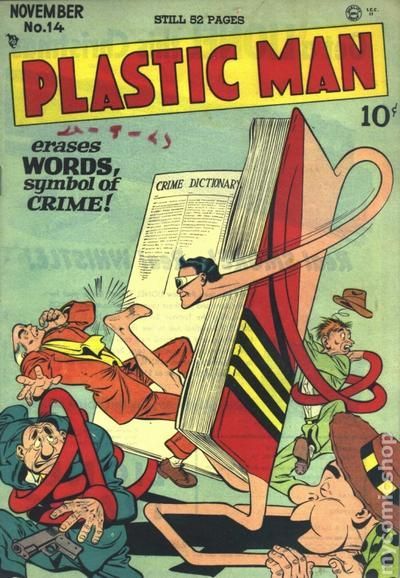
So whenever I hear “flexibility” I think of the tragic figure of Plastic Man, who fell into a toxic tank at a plastics factory, and whose great gift and terrible burden is the ability to wrench himself into whatever object his current task requires. A nimble organization maximizes productivity while minimizing labor costs. It also requires flexible employees who can bend into as many different shapes as possible. A “nimble” bureaucracy is therefore populated by “flexible” people who are, in this framing, creative, vigorous, and gymnastic. And yet as I wrote about “nimble,” much of the current language of austerity imagines corporate businesses as bodies in virtually every way except as a group of overextended or underpaid ones. Those who use the term “flexibility” imagine themselves as great pragmatists, quantifying “competencies” and “efficiencies” wherever and whatever they may be, sweeping away all abstraction and uncertainty into a spreadsheet. Less moralistic than “nimble” and less prophetic than “innovation,” the concept of “flexibility” still retains some of the esoteric pixie dust that surrounds the cult of the innovator. “Innovation” frames wealth as the natural product of market-driven, individualistic, visionary creativity. With “flexibility” and the right software, our bosses can even conquer time, and bend it, along with us, to their immediate requirements.

image