The book examines how Americans have mapped the hemisphere from the mid-19th century to the end of the Cold War in terms of an economic geography in which the United States was a rich nation among poor ones. Yet to define this flattering distinction, U.S. intellectuals routinely resorted to comparison: to some observers, Latin American poverty resembled the United States’ past. To others, it looked like uniquely troubled parts of the country, like the rural south or the urban tenements. Instead of demonstrating a clear-cut relationship of dominance and subordination, in other words, U.S. readings of Latin America look like the swings of a pendulum, in which Latin America moves from confederate to competitor, from familiar neighbor to exotic adversary.
A Cultural History of Underdevelopment looks at how economic terms came to define national difference, and how the most enduring such term, “underdevelopment,” emerged out of nineteenth- and twentieth-century U.S. readings of Latin America and Caribbean culture. The book traces a set of popular conventions for representing Latin America and the United States’ relationship to it, in travel writing, journalism, literature, film, and photography: as a place of “tropical” wilderness, cultural vitality, revolutionary violence, and heroic possibility. These conventions identify Latin Americans variously as good neighbors and insurgent threats, as images of the United States’ possible future and as relics of its past. Rather than a simply exotic place, Latin America has been the United States’ vanity-mirror, where Americans have glimpsed a flattering reflection of themselves. It has also been a place where U.S. thinkers have seen their own country’s uneven development staring back at them.
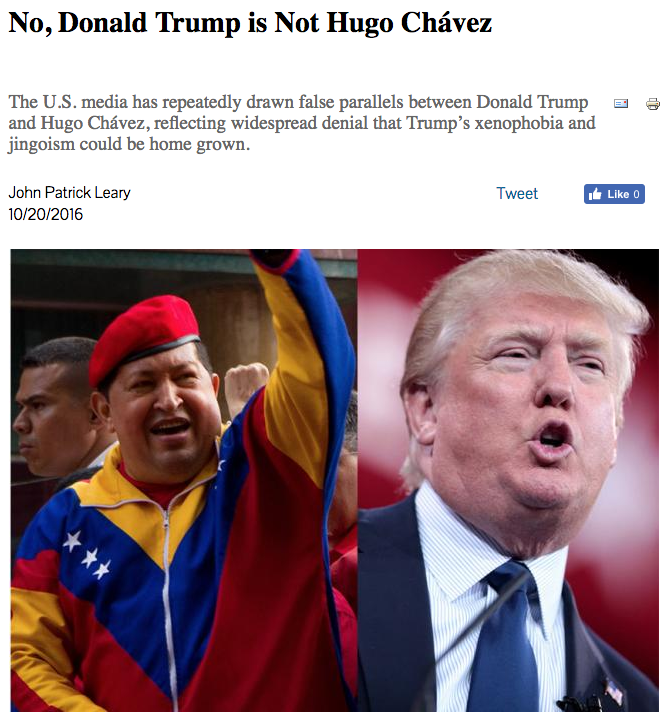
Check out my piece in NACLA today about the endless parade of Donald Trump-Hugo Chávez in the news media, why they’re wrong, and why they’re so irresistable to liberal critics.
It’s that time of year again, for fake applications to jobs that don’t make any sense. The Khan Academy is an internet “school” that claims to “provide a free world-class education for anyone, anywhere,” mostly via video lectures. Here is my cover letter for the “World History Content Fellow” position, which I found advertised here. The job description: to “help build out our video library in world history and create practice exercises in world history, US history, and US government at the advanced high school and intro-college level.”
Hillary Clinton’s open letter to “millennials” has had a lot of people talking. Much of the letter is a boiler-plate appeal to a generation that she claims to really really like, even if the feeling hasn’t been mutual. A lot of public discussion focused on her choice of the adjective “entrepreneurial” to describe people under 30. Clinton (or rather an unnamed campaign operative) says:
Your generation is the most open, diverse and entrepreneurial generation in our country’s history. And if we work together to take on the barriers that are holding you back and unleash your full potential, that won’t just improve your lives — it’ll make our entire country stronger.
It’s unclear, first of all, what it means to describe a generation as more “open” than another. Like “open,” and arguably “diverse,” “entrepreneurial” describes a set of attitudes that can’t be easily defined, much less quantified in any clear way. So what does Clinton mean by an “entrepreneurial” generation? On the one hand, as is always the case with “entrepreneurship” as a concept, she doesn’t mean anything. The millennial generation did not invent private property or exchange value, and thus cannot be said to be more entrepreneurial in spirit or fact than any other. It’s a word whose ideological meaning far outstrips any other significance it has. (2/3 of Americans under 30 are wage earners, so there’s that.)
Here and throughout the campaign, Clinton uses it as a synonym for “innovative.” Both terms clearly refer to a talent in starting and operating private businesses, and a kind of zeal for competition and the marketplace. This comes, of course, with the added suggestion that young folks, those digital natives, are particularly good at computer things. The tone-deafness of this particular appeal, as many have observed, lies in the fact that “millennials” as a demographic voted by a large margin for a socialist, not a pro-business liberal. What Clinton alludes to in this letter, but does not say, are some of the reasons for this leftward generational shift: the burdens of student debt, high housing costs, structural unemployment, general government disinvestment in any source of employment that doesn’t require use of a weapon.
So, even if you were to accept that people under 30 under more “entrepreneurial” than their elders, you would have to ask why. “Entrepreneurship” in Clinton’s terms therefore seems like a dressed-up version of what Lester Spence, in his important new book Knocking the Hustle: Against the Neoliberal Turn in Black Politics calls “the hustle.” Much like “creative” and even “millennial” itself, “entrepreneur” has an implicit class and racial connotation in the press and among politicians: they all a summon an unspoken middle-class whiteness unless stated otherwise. “Entrepreneur,” in particular, usually suggests a white tech worker or startup founder, plotting his (and it’s usually his) business over a laptop in a gentrified urban coffee shop or a California exurb; an entrepreneur, moreover, chooses this vocation, as the endless magazine articles chronicling the “entrepreneurial journey” attest. The “hustle,” on the other hand, comes to you, and it promises survival, but never wealth. As Spence writes:
The hustle. The concept of the “hustler” has changed somewhat over the past thirty years or so. Whereas in the late sixties and early seventies the hustler was someone who consistently sought to get over, the person who tried to do as little work as possible in order to make ends meet, with the “hustled” being the people who were victimized by these individuals (“He hustled me”), the hustler is now someone who consistently works. I can’t go a week on the subway without seeing someone sell incense, or gloves in the winter. I can’t wait for the MTA 22 bus at Mondawmin mall for more than ten minutes without running into someone selling “loose ones” (individual cigarettes), or bottled water during the summer. And the hustle rather than being the act of trying to get over has now been transformed to the point where it means the exact opposite—”hustle” and “grind” are now often used interchangeably.
Selling bottled water on the street is literally entrepreneurial activity, but this isn’t what Clinton means. But in another sense, it’s exactly what she means, if we read Spence’s analysis of “the hustle” as symptomatic of broader shifts in the neoliberal economy that fall particularly hard on black workers. The most indebted generation in recent history, facing its worst and most unstable job market, compelled to work longer and study less than their forebears, might just be the most “entrepreneurial” in recent memory. “Entrepreneurship” sure sounds a lot nicer than “the grind.”
In my article in Jacobin last week on the phrase “officer-involved shooting,” I wrote about how, for police and their spokespeople, wordy sophistry is a kind of tradecraft. The phrase “officer-involved shooting” obscures meaning and deflects agency through a performance of dispassionate, bloodless authority, by which many journalists seem easily seduced. For this reason, police are invested in policing the language others use to describe the work they do.
As an example: In “Defining Unarmed,” an article published on the website of the Houston Police Officers’ Union, Barbara Schwarz would prefer to do away with the adjective entirely. (She doesn’t define “unarmed” so much as empty it of any practical meaning at all.)
Message to the protesters and the news media: assault is color blind and no individual is “unarmed. ”
According to the law of the streets where these assaults occur, there is no “unarmed” individual.
In the “law of the streets”–by which the Houston police are, for some reason, now bound–fists are a deadly weapon. The “empty hand has been defined as a deadly fighting art,” Schwarz writes, a reading that brings the meaning of “arms” as weapons and the anatomical definition into an absurdly literalist alignment. As long as you have arms, in other words, you can never be “unarmed.”
In the genre of “free college” rebuttals I discussed last week, the Clayton Christensen Institute education policy director, Julia Freeland, has written one of the most execrable. Ridden with entrepreneurial jargon and redolent of a self-serving profiteering approach to education, her CNN op-ed described universities as a “broken business model.” This is in keeping with the Christensen Institute’s general philosophy of honoring its namesake by evaluating every institution as if it was a for-profit corporation like the ones in Christensen’s book, The Innovator’s Dilemma. We should all have a business model as lucrative as the think-tank industry’s.
Free-college critics are motivated by an elitist view of higher education, in which tuition is a gatekeeper as much as a revenue stream. So one of Freeland’s “solutions” to the problem of high college costs is to shift more low-income students out of college altogether and into things like “college bootcamps.” (As I wrote earlier, Hillary Clinton is a fan of something similar, the for-profit coding academies that are sometimes known as “coding bootcamps.”) These “bootcamps,” Freeland writes, aren’t just trade schools: they’re “experiences,” whatever that means, which cost somewhere “between $5,000 and $15,000, and show extremely promising post-completion employment rates,” although she doesn’t specify where or in what fields.
It struck me as a fitting use of the term, in a way. Where Vietnam-era college deferments once bought middle- and upper-class students out of the draft and out of bootcamp, now a new generation of working-class 18 year olds can aspire to metaphorical “bootcamps,” which may keep them out of the military version (at least for now) but also still keeps them out of college.
The word’s origins lie in the de-individualization that military bootcamp is meant to instill, as raw recruits are acculturated to the service and the unit. According to the OED, WWII-era Marines were known as “boots,” a metonymic reduction of the soldier to his equipment that we still routinely hear when hawkish politicians call for “boots on the ground.” The place where a man or a woman became a “boot” became known as “bootcamp.”
The metaphorical use of “bootcamps” to mean any kind of intensive training became popular in the 1990s, which a quick survey of the Google ngram data will show. The word first comes into use before the second world war, picks up during the conflict, and enters wide usage after Vietnam.
It really takes off in the 1990s, by which time many uses were metaphorical, rather than actual accounts of military training. It’s hard to say definitively, but I read this as a consequence of the militarization of society at large, and the remoteness of military combat abroad, in the last few decades. The military is ever-present, but since the 1990s, it has become such a regular, banal media fixture that it was easy to associate the distant carnage we saw on video-game smart bomb footage from the “boots” training to unleash it and to suffer it. Now, 15 years into the “War on Terror,” you will find that most journalistic uses of the term now have nothing at all to do with the military. So as the home front becomes militarized, the ubiquitous warfront becomes invisible: “bootcamps” for all at home, and endless war for the “boots” abroad.
People who have never been in the military, like me, probably still associate military boot camp with traumatic movie versions like the one in Full Metal Jacket–making its civilian popularity outside of the prison system especially bizarre. There is perhaps more to be said in another post about what it means to invite Gunnery Sergeant Hartman and his regime of discipline and self-abnegation into every sphere of life, from exercise and marriage to job training and, as we’ve seen, higher education.
But for now, here is a brief and provisional list of the bootcamps that will not prepare you to wage war in Iraq, Afghanistan, or Baltimore:
Yoga on the Rocks, a Total Body Bootcamp
Nutrition Bootcamp
Fitness Bootcamp
Bikini Bootcamp
Shutter Creek Correctional Institution, a prison bootcamp
When I was in college at a midwestern university famous for its right-wing economists, the coffee shop in my dorm was called T.A.N.S.T.A.F.L., which stood for “There Ain’t No Such Thing As A Free Lunch.” It was a quotation from Milton Friedman, who I suppose used it to mean that someone–the owners of capital–are the ones paying for what workers, mothers of dependent children, Chilean miners, or whomever are merely taking, as if it were “free.”
Of course, there isn’t any such thing as a free lunch, but it’s not because someone else is paying for it. It’s because someone is working for it. But that’s not what Friedman meant, and it’s not what critics of tuition-free college mean when they dismiss “free college” as a pipe dream. The derisive use of “free” in the TANSTAFL libertarian sense has experienced a revival, especially around the issue of tuition-free, publicly-funded higher education, or to its critics, “free college.”
As in the case of the Friedman aphorism, “free college” is often invoked with an air of world-weary condescension, as if the adult speaker is patiently explaining to someone else’s child why, although they really, really wish he could, he simply cannot have a pony.
Sara Goldrick-Rab shared this excellent example on Twitter.
Sandy Baum: “Its not realistic to say we’re going to pay people to go to college [for free]. Someone has to pay.” https://t.co/vikvcb7KNh
Her comment points out the arbitrariness of Sandy Baum’s insistence that publicly-funded college is among all public services singularly impossible and unthinkable. It also points out the non-sequitur of the whole argument–no one ever said “free” high school or playgrounds were free, either. My sense is that this kind of dismissal is often a combination of class prejudice, politics, and narrow-mindedness. It comes out of a conviction that college should remain an elite preserve, with a sticker price to ensure it, plus an obliviousness to the normalcy, within recent memory, of tuition-free (or nearly so) college in the United States, to say nothing of the rest of the world.
Most critics of Bernie Sanders’ tuition-free public college program were also just opportunistic political supporters of his rival in the Democratic primaries; there’s no need to review the terrible arguments that subsidized SUNY tuition would be a giveaway to Tiffany Trump. (She should have to buy a ticket to Central Park, though.)
Here is another example, a paywalled article in the Chronicle of Higher Education that explains “How Clinton’s ‘Free College’ Could Cause a Cascade of Problems” (a veritable cascade! I bet you haven’t even thought about all the problems.) Reasonis, of course, opposed to it, arguing in the face of common sense and all evidence that “government subsidies have hidden the price of college and broken the market forces that would naturally keep tuition costs down.”
An op-ed writer in the Delaware News-Journal does a point-by-point debunking of what he calls the “myths of free college,” tipping his hand by quoting such scholars as William Bennett and Kevin Carey without ever addressing the core issues that the Sanders campaign first raised–federal and private profiteering on student loan debt and the decline of federal and state aid for education.
“Free college” is a moralistic ruse, in other words, used to smuggle in a market logic where it has no place without addressing the core question of exploitative, exorbitant college costs. It treats education like anything else you’d buy in a store, and scolds those who feel otherwise by pretending they want to get something without working for it. There ain’t so such thing as a free lunch, of course: students and the public have amply paid for it already. They’re just not eating.
Luckily, most Americans seem to understand this: a recent surveyshows that two-thirds (and one-third of registered Republicans) think “tuition at public colleges and universities should be free for anyone who wants to attend.”
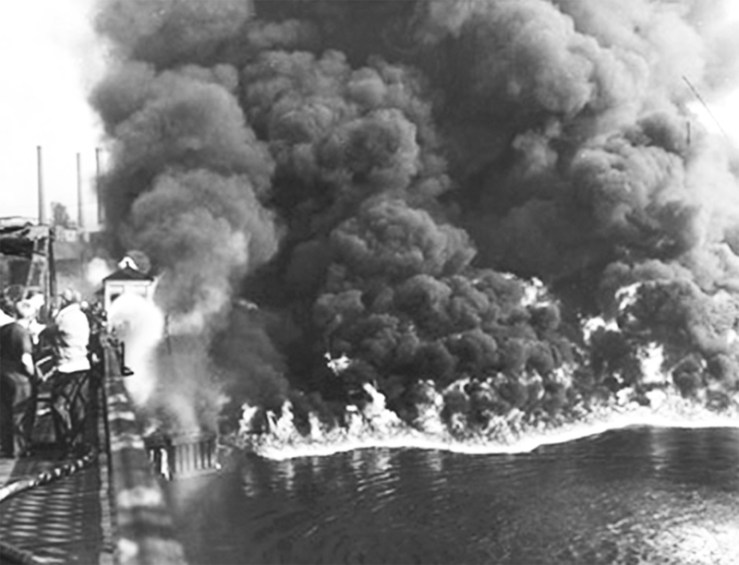
In 1968, Cleveland finally had some good news: thousands were out of work, but at least the deindustrialization of its riverfront was making the Cuyahoga River less polluted. By 1969, of course, the river was on fire. So much for good news.
But Peter Thiel, who like his patron Donald Trump styles himself as alternately a Jeremiah of national doom and our prophet of deliverance, remembers it differently.
[T]his isn’t the dream we looked forward to. Back when my parents came to America looking for that dream, they found it right here in Cleveland. They brought me here as a one-year-old and this is where I became an American. Opportunity was everywhere. My dad studied engineering at Case Western Reserve University, just down the road from where we are now. Because in 1968, the world’s high tech capital wasn’t just one city: all of America was high tech.
It’s hard to remember this, but our government was once high tech, too. When I moved to Cleveland, defense research was laying the foundations for the internet. The Apollo program was just about to put a man on the moon–and it was Neil Armstrong, from right here in Ohio. The future felt limitless.
Now, no offense to Cleveland, and maybe Neil Armstrong was “from…Ohio,” but amidst all the nonsense in Thiel’s speech, this paean to late-60s Cleveland as the paragon of 20th-century progress was the silliest part. Despite Thiel’s loathing for what he calls identity politics and “culture wars”–which he immediately followed in this speech by mocking transgender people–he is playing desperately to the most rigid and unforgiving form of identity politics we have, white nationalism.
OMG. Thiel: “Fake culture wars only distract us from our economic decline.” #RNCinCLE#irony
The old-fashioned Jetsons fantasies of mid-century American futures that Thiel loves so much–moon landings, flying cars, you know, everything you think of when someone says, “Cleveland”–are the twin to Trump and Thiel’s thunderings about “national decline.” “Stagnation” and “decline” are popular themes of Thiel’s–he talks about it constantly, sometimes denouncing Silicon Valley itself for not thinking “big” enough (“we wanted flying cars, we got 140 characters” is one of his signature witticisms). His reference point is always the mid-century America of Marty McFly, when a strong state dreamed big technological dreams.
And like most forms of cultural nostalgia indulged by American white people, the subtext, and sometimes just the text of this talk of “national decline” is a racist identity politics. It’s a fantasy of a Cold War golden age when the only non-white people they can see are on stage doing “Earth Angel.” So when Thiel pontificates about “national decline,” by which he means the fall of U.S. empires abroad and a fragile white masculinity at home, bring on “national decline.”
In Denver on June 27, Hillary Clinton announced a “technology and innovation agenda” that focused in large part on education, yet another sign that for both Democratic and Republican politicians, “education” really only means “job training” for the private sector.
Her proposal included two major education subsidies: $10 billion in aid for students in massive open online courses, or MOOCs, and “vetted” coding academies like Galvanize, Inc., the for-profit Denver school where she made her announcement. Even as MOOCs have come under heavy scrutiny for their shoddy pedagogy and for-profit schools for their profiteering, Clinton has proposed a huge federal investment in what her supporters often shorthand as “innovation.” (If it’s online and someone makes money on it, it’s called innovation.)
The second major subsidy is a student-loan deferment program to “entrepreneurs,” in which the federal government would defer the loans and subsidize the interest of startup founders and “their first 10 or 20 employees” during the first three years of their business. This raised hackles: why is it a “progressive” idea to make student loan debt conditional on your profession or, given the education and family connections of many startup founders, your class position? Why not defer the debt of social workers or nurses or teachers, who don’t stand to reap the financial incentives tempting tech workers? (One possible answer: social workers don’t donate as much to federal election campaigns as Silicon Valley CEOs.)
Perhaps anticipating such critiques, Clinton’s proposal including some do-gooding overtures to “young innovators” working in “distressed communities,” or those starting business that provide “measurable social impact and benefit.” As any debt-burdened English major could tell you, though, a lot depends on what “distressed,” “measurable,” and “benefit” mean.
A lot depends on what “entrepreneur” means, as well. You would expect, as often and as worshipfully as politicians throw the word around, that “entrepreneur” would have a pretty clear definition. The Austrian economist Joseph Schumpeter, first theorist of “entrepreneurship,” used it in alternately humble and grandiose ways. On the one hand, the entrepreneurial function simply “consists in getting things done,” he wrote.
Elsewhere, though, Schumpeter described entrepreneurship with a grandeur that his admiring biographer Thomas McCraw said “came near to being an allegory.” Entrepreneurs are “New Men,” the heroes of the capitalist Sturm und Drang (Silicon Valley entrepreneurs are mostly just, well, regular men).
If used as a model, his classic text Business Cycles might trouble whoever is tasked with drafting a Student Debt Forgiveness for Entrepreneurs Bill in the Clinton White House: “It is not always easy to tell who the entrepreneur is in a given case,” he wrote. “Nobody ever is an entrepreneur all the time, and nobody can ever be only an entrepreneur.” The entrepreneur may be an inventor, or he may work for him; he may be an entrepreneur this quarter, but not the next. In Schumpeter’s account, it’s not a job description—it’s a practice and an ethos.
Entrepreneurship: at least it’s an ethos
And it’s obviously tricky to craft federal subsidies for an ethos. Who are the “entrepreneurs” of the tech economy whose support Clinton covets so dearly? Is it the CEO? The venture capitalist, who provides the startup investment? The customer-service rep, or just the boys that write the code? And if the answer is “everyone,” this would seem to present a problem, not only practically but politically: the federal government would not only be deferring the debt of company founders, but also subsidizing a part of their wages and benefits.
In the end, “entrepreneur” in our time, like in Schumpeter’s, means something very specific and impossibly vague. On the one hand, it either means “tech firm executives” or “small business owners.” Clinton observed in her Denver speech that “It’s not an accident that Denver and Colorado have a low unemployment rate,” suggesting that coding academies like Galvanize Inc. are responsible for the robust job market. According to the Colorado Labor Department, the state’s largest job gains over the last year have been in the hospitality, construction, and education fields. Even government employment outpaced business services, information, and finance. (Colorado Parks and Wildlife are hiring.)
In its vaguer, though no less popular sense, “entrepreneurship” is used increasingly to describe any white-collar, profit-making activity, whether financial or commercial, speculative or productive, high-tech or manufacturing. It is still not a profession, but an ethos, a calling, a heroic character in a dull, derivative plot. In our new gilded age, when wealth and its pursuit are treated with such reverence, the biggest meaning of “entrepreneur” is ideological–to celebrate the pursuit of private wealth as a public good, which the public should in turn pay for.





 Keywords: The New Language of Capitalism