Keywords for the Age of Austerity: Innovation in Action Part 1: Entrepreneurs, New Men, and Student Loans

An occasional summer feature here on the blog, where we will take a “deep dive” (as they say) into some example of “innovation,” as it does its sometimes nefarious, sometimes simply confusing, work in the world.

As so many of the keywords have shown, the vocabulary of austerity is deeply moralistic: austerity is framed as a just punishment for past profligacy, a form of necessary self-discipline. “We must tighten our belts,” say the service-cutting politicians, framing the nation as a regretful drunkard stumbling to the gym on January 2, ready to punish itself for its misdeeds.

Another example of this moralism, hot off the presses this morning from Hillary Clinton’s Silicon Valley CEO fundraising drive  announcement of her “technology and innovation agenda,” is her breathtakingly terrible proposal to forgive student loan debt to “entrepreneurs.” At the risk of pointing out the obvious–how is it a good or “progressive” idea to make student loan debt conditional on your profession or class? Why not forgive the debt of social workers or paramedics or teachers, who are also plagued by loan debt? This is besides the point, though, since the plan is so obviously cynical–clearly Clinton has no plan of implementing a policy that is so obviously unimplementable.

The reason, as we explored in Keywords for the Age of Austerity 4, is that “entrepreneur” doesn’t really mean anything. Joseph Schumpeter, the mid-century Austrian theorist of innovation who thought it did mean something, used it to describe those who brought about some sort of technical or organizational transformations within a firm or industry. Any precision here begins to to evaporate pretty quickly, however. In Business Cycles: A Theoretical, Historical and Statistical Analysis of the Capitalist Process, Schumpy makes an observation that would probably trouble the lawyers drafting the imaginary Student Debt Forgiveness for Entrepreneurs Bill:

It is not always easy to tell who the entrepreneur is in a given case. This is not, however, due to any lack of precision in our definition of the entrepreneurial function, but simply to the difficulty of finding out what person actually fills it. Nobody ever is an entrepreneur all the time, and nobody can ever be only an entrepreneur.

Schumps often describes the entrepreneur as a kind of mythical, allegorical character. It’s not a job description, but an ethos. Elsewhere, the entrepreneurial class are the “New Men” (in caps) who bring about “innovation.” “We will assume,” he writes, “that innovations are always associated with the rise to leadership of New Men. Again, there is no lack of realism about this assumption,” he insists–this is a a thing he sometimes does, following some admission of the mythical character of the entrepreneur with some insistence that no, it really is quite sensible and hard-headed.

che-che-guevara-18487056-379-480
not his kind of New Men

All this is to say: I doubt Hillary Clinton has any intention of forgiving entrepreneurial student loan debt, since “entrepreneur” is not a clearly defined, or indeed clearly definable category (though I am prepared to be proven wrong). For Schumpeter, what the idea of the entrepreneur seems to do is to give a narrative shape and a heroic protagonist to the upheaval turbulence of capitalism. For Clinton, the only real definition is ideological–to valorize the pursuit of private wealth as a public good.


What we do and what we say

Yesterday, Hillary Clinton acquiesced to Donald Trump’s demand that she name the  massacre at Orlando’s Pulse nightclub as a product of “radical Islamism.” Her supposed failure to do so had become something of a cause celebre on the radical right, and Donald Trump claimed a victory in making her say it.

Trump’s preferred term is “Radical Islamic Terror” (elsewhere, simply “Radical Islam,” also in title caps), but Clinton presented her response in typical fashion–as a little red meat to the xenophobes she’s now courting, seasoned with a little bit of good-government militarism for the liberal supporters she already has. She began by belittling Trump for focusing so much on semantics.

[I]t matters what we do, not what we say. It mattered that we got bin Laden, not the name we called him.”

Military actions, not words, are what matters. But then, she continues, if it means that much to you, fine, whatever, I’ll say it.

“But if he is somehow suggesting I don’t call this for what it is, he hasn’t been listening. I have clearly said that we face terrorist enemies who use Islam to justify slaughtering innocent people. And, to me, radical jihadism, radical Islamism, I think they mean the same thing. I’m happy to say either, but that’s not the point.”

The right-wing blog Red State huffed illiterately in response:

Sure it matters what we do, but it also matters what we say. Curing disease is nice but you sorta have to understand what the disease is and it is useful if the disease has a name so cancer and smallpox and boils on the ass aren’t all called “maladies.”

Nowhere in Red State’s statement on this semantic controversy is Omar Mateen’s target–a gay nightclub–ever mentioned. Trump buried it in the third paragraph of his statement, obliquely saying that “Radical Islam advocates hate for women, gays, Jews, Christians and all Americans.” Instead, the shooter’s plainly opportunistic and delusional claim of ISIS inspiration has predictably inflamed a media and political establishment so enamored with ISIS that if the terrorist bogeymen didn’t exist, they would have had to invent them (oh wait–they did!)

But since this is a language blog, why the obsession with naming the attack “radical Islamism”? Red State is right, insofar as words and more broadly, the ideologies they shape, cannot be separated from actions as Clinton claims they can. But the political meaning of the word “Islamism” is, of course, not what they think it is.

Islamism, in fact, peaked between 1820 and 1840, where it was used synonymously with “Mohamedanism,” as you can see here.

Screen Shot 2016-06-14 at 1.48.26 PM.png

(Islamism with a capital “I” gains in popularity through the later half of the 19th century.)

There, as now, “Islamism” was used with hostility, to denote a superstition or an apostasy. Like “popery,” it named the religion as a set of deviant practices. The Anglican Orientalist Charles Foster, archbishop of Limerick in Ireland and a prolific author on Islam, made this equation between “Islamism” and “Popery” explicit. “Islamism is the Popery of Ishmaelism,” he wrote in an 1830 book defending his earlier tract Mahometanism Unveiled. “Popery,” “Mohametanism” and “Islamism” were intended to define Islam or Catholicism as superstitious and subversive practices, rather than coherent belief systems of their own. Hence the all-important important suffixes, which identify the religions not as faiths but as actions–Catholics are conspiratorial agents of the Roman pontiff, and “Mohametans” the proselytizers of the “Ishmaelite heresy.”

The point now is less theological than it is political, nationalist, and racial, but I’d say the basic meaning remains–you can’t honestly declare war on “radical Islamism” and also disown the racist discourse of a “clash of civilizations,” as Clinton would have us believe, which is why Red State and Trump are so invested in the phrase.

The Cultural Frontline: “Why I Miss Ruin Porn”

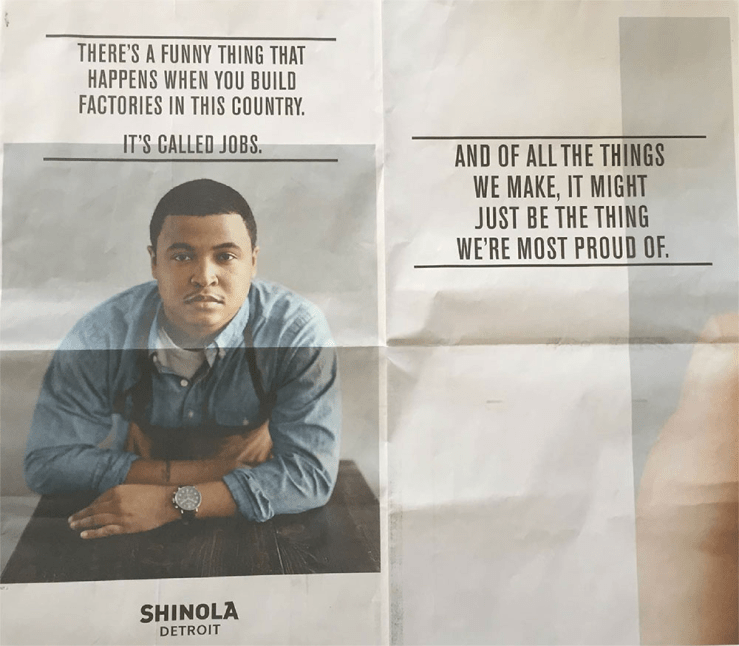
The title’s a little tongue-in-cheek, but only a little. I appeared on the excellent BBC World Service program The Cultural Frontline this past Sunday, critiquing the visual and journalistic heir to the “ruin porn” of post-2008 Detroit. NB: the “luxury goods brand” exploiting the image of Black, working-class Detroit to promote brand authenticity is definitely not Shinola, which pays its grateful workers $11.50/hour to manufacture watches that cost $500 and up.

2016-02-shinola-ad

Stream this episode here, or download the mp3 file here.


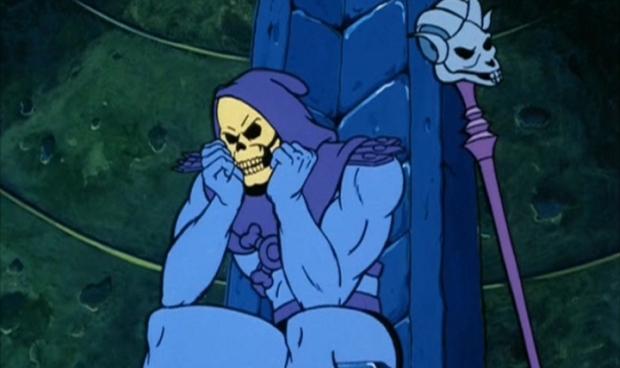
Who Said It? Donald Trump or Skeletor?

From tonight’s Lager House Pub Quiz:

skeletor_sulking

  1. It is better to live one day as a lion than 100 years as a sheep.
  2. Books are the real treasure of the world!
  3. The point is, you can never be too greedy.
  4. I’m so powerful, I even impress myself!
  5. I could write a book about what you don’t know!
  6. I can actually make my enemies tell the truth.
  7. These are low level degenerates, not masterminds!
  8. Why do I surround myself with fools?
  9. Sad!
  10. Impressive, you boob!
  11. [cackles evilly]


Answers: 1) Trump; 2) Skeletor; 3) Trump; 4) Skeletor; 5) Skeletor; 6) Trump; 7) Trump; 8) Skeletor; 9) Trump; 10) Skeletor


Wednesday Night Fights: The Man vs. The Establishment vs. The System

The latest in an irregular series, in which two–or, in this case, three-similar words enter, and only one–or, in this case, two–leave.

The primary season has reintroduced us to “the “establishment,” a concept just as often ironically capitalized as “the Establishment.” But how is “establishment” different from the two other most popular shorthand names for the structures that order our lives: “the system” and the most figurative one, “the Man”?

“The man” is hardest to trace, since the African American vernacular phrase vanishes into the databases that capture any use of the word “man” and the definite article. Slang dictionaries date it to the 1940s, where it referred to “the white ruling class.” In some of his work, James Baldwin emphasized that the man was embodied by the cop but he resided, as well, at work: “And the others, who have avoided all of these deaths”—from heroin, exhaustion, Korea, or the police—“get up in the morning and go downtown to meet ‘the man,’ he wrote in “Fifth Avenue, Uptown.” In his harrowing short story “Going to Meet the Man,” which is told from the point-of-view of a southern policeman, Baldwin emphasized what a poisonous mixture of of sexual repression and self-loathing there is in “the man” himself. But the man, like “establishment,” has suffered a sort of sneering fate recently—“sticking it to the man” is how some ironic office worker might now describe refusing to clean the microwave in the office break room.

“The man,” like “establishment,” summons the 1960s and 70s, the high-water marks for each. Mark Leibovitch takes on “establishment” in the latest edition of the New York Times Magazine’s “First Words” column, a series of essays on the politics of popular language about which this blog has struggled to maintain a polite silence so far. His column is an anecdotal account of establishment’s popularity in the 2016 presidential campaign, but his tone of raised-eyebrow bemusement at the proliferation of the “Establishment” is also a good example of the term’s historic uses. That is, the word has been used by members of some establishment to describe its challengers or critics just often as it has been used by those very critics. Leibovitch writes:

The establishment represents a catchall designation for ‘people in charge’ — and implies that they’ve been ensconced too long. The establishment is tired and musty and too comfortable. Yet it is still invoked constantly as a phantom solution: The establishment will step in and bring order to this chaos. They are the parents that will arrive home just as the party has grown out of control, the house is being trashed and the cops are taking names.

His metaphor of angry parents gets at something important. “Establishment” is used less often by radicals and activists than by members of the establishment who condescending to them or trying to co-opt them. The Establishment is orderly, rational, reasonable; the anti-Establishment is churlish, irrational, led around by its teenage passions. These anti-Establishment radicals, of course, are usually young, and given the role of so-called “millennials” in the Democratic primary, this explains a lot about the word’s resurgence.

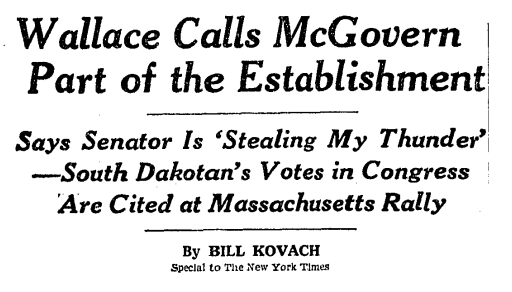
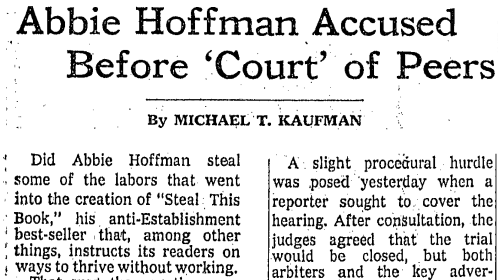
George Wallace, in his Trump–like 1972 presidential campaign, liked to style himself as the anti-establishment candidate, accusing George McGovern of “stealing his thunder” in that respect. Screen Shot 2016-03-14 at 1.26.23 PMAbbie Hoffman, who embodied the white “anti-Establishment,” was brought up in an improvised court of his peers for plagiarism, which to a reporter in 1971 was just the most delicious contradiction. (But aren’t courts…the Establishment?!? Game, set, match, Yippies.) Charles Manson “preached a mixture of love for fellow men and hatred of the establishment to his devoted followers,” wrote the Times after his arrest. And Jimmy Hoffa, according to an unsympathetic 1967 profile, “played to the hilt the fiction that he was the persecuted Everyman, the scapegoat of the Establishment.” In none of these examples does “the Establishment” actually exist—it’s a fiction that ideologues concoct to deceive the gullible.
Screen Shot 2016-03-14 at 2.03.42 PM

In the summer of 1968, Time magazine wrote:

The anti-establishment forces at work in the U.S. today-black militancy, the poor people’s crusade, the antiwar movement, student riots and demonstrations over these and other issues-are comparable in causation if not degree to the upheaval in France. In both countries, and many others, the malaise reflects the resentment of those who feel that they have been neglected, ignored or oppressed by outdated, inflexible political and bureaucratic systems.

I doubt you could have found many Black Panthers who would have complained about their neglect by the state—they would have welcomed a little more police neglect, as opposed to the alternative. This is a common liberal response to moments of political dissent, echoes of which resound in the campaign media today. Look at Paul Krugman, who calls Bernie Sanders a “demagogue,” not because he is mobilizing a mob, as the OED would require, but because to him, all militancy is “the mob.” (Whether or not Sanders is militant is another question; the point is that Krugman thinks he is).
aesthetic-lisa-simpson-rebel-system-Favim.com-3828123

“Anti-establishment” politics is all personal, that is, as motivated not by coherent grievances but by feelings that are only skin deep–anger, “malaise,” as Time said, or a loyalty to a leader. This reading of the radical as irrational is extended most of the time to people of color, the post-colonial world, especially Latin America. It also extends to young people in general, to feminists, and only occasionally to supporters of white men like Sanders and Trump.

CDfjBB3UEAAbbkW

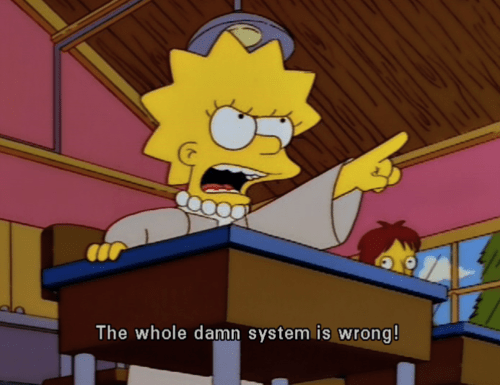
“System,” by contrast, is usually spoken in earnest. It has more in common with “power structure,” the term that along with C. Wright Mills’ “power elite” seemed to be more popular than “establishment” by intellectuals on the left in the 60s. “Systems” name particular institutional locations of oppressive authority—the criminal justice system, the banking system, or the interlocking network of all of these–“the system.” By its nature, a “system” is oppressive, since we tend to think that system constrain rather than facilitate freedom. A system is less amorphous than “the establishment”; it can be named and opposed more clearly.

As Leibovitch says, “the establishment makes for a potent straw man in the hands of people who otherwise might not know precisely what they’re fighting, only that they’re angry and frustrated.” The establishment is certainly a political straw man, now as ever, attacked opportunistically and selectively. But so is “the Establishment”–the concept itself. In its historic and current usages, there is either a) no such thing as the Establishment b) there is such a thing, but it’s not so bad, it basically just means you’re white and from New England, and/or c) there is an Establishment, and it’s opposed by impassioned, malaise-y young people. Whatever it is, you can’t beat the Establishment, you can only join it. Where’s my column, New York Times Magazine?

Winner: The Man and The System, in a tag-team KO.


“Voodoo Economics”

Paul Krugman, self-proclaimed “wonk” and liberal economist,  is today denouncing what he loves, absolutely loves, to call “voodoo economics.” What is “voodoo economics,” you ask?

“Wonk wonk wonk wonk wonk wonk wonk. Wonk wonk wonk”

It’s what it isn’t. Today in the Times Krugman  sides with a group of Democratic Party economists who proclaim, without irony, that they speak for the party of “responsible arithmetic.” This celebration of rationality and arithmetic as neutral, apolitical values is a classic liberal ideological move, an ideology that denies its own existence. Only naughty people have interests and ideologies, as Raymond Williams summed up this usage; sensible people just have, well, arithmetic. (As if thieves and plunderers can’t add up their loot correctly, as if subprime mortgages and meth labs aren’t “innovation.”)

Krugman makes a more cautious version of the same argument in his column criticizing Bernie Sanders’ economic program as “voodoo economics.” Whatever one thinks of Sanders (I’m a pessimistic supporter), I think Matt Yglesias is correct to point out that the campaign is a challenge to this Clintonite pretense of non-ideological centrism, openly embracing politics as a field of conflict, rather than consensus. In such a scenario, you have to stand for something other than “arithmetic.” For this reason it’s not so much that Krugman is wrong on the numbers (I am bad at arithmetic and therefore regard it as basically a bourgeois deviation) as missing the point.

Screen Shot 2016-02-19 at 10.11.55 AM
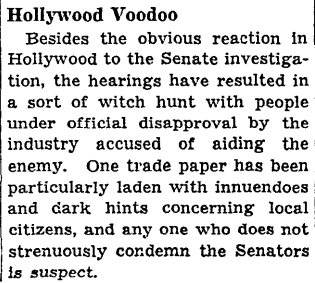
From the New York Times, Sept. 28, 1941: “voodoo” and HUAC’s ideological “witch hunt” 

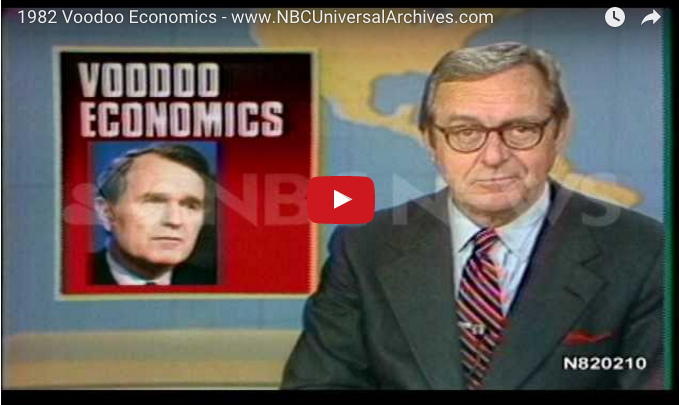
Back to the “voodoo economics” thing: the phrase was coined by George Bush, the elder, who used it during the 1980 Republican primary, when he was running against Ronald Reagan. From there, the phrase has enjoyed a long career as a liberal accusation against Reagan and Reagan-inspired conservatives, thanks in no small part to Krugman. Michael Parenti defined it this way in a chapter called, appropriately enough, “Voodoo Economics: The Third-Worldization of America“: “voodoo economics is supply-side economics, a trickle-down ideology that goes something like this: If left to its own devices, the free market will provide prosperity for all who are willing to work. Liberated from the irksome and artificial constraints of government regulations and heavy taxes, private investment will grow, bringing greater productivity, more jobs and income for everyone, and less government.”

George H.W. Bush’s first use of the term, his denial, and exposure

It’s not clear to me what exactly Bush meant by the term, except as a memorable phrase in an intra-party feud. One can presume, however, that for a Republican Party well on its way to becoming the all-white party of reaction it now is, disparaging your opponent by affiliation with Haitian or southern African American culture can’t hurt.

Krugman uses it in more or less Parenti’s way, to impugn Republican tax-cut plans by comparing them to “black magic.” Putting aside its racist implications, he’s kind of obsessed with “voodoo” and you could say he should stop using it purely as a matter of style. For Krugman, “voodoo” is a  term of art in an ideological dispute. Its appeal relies on vodou’s enduring reputation in the United States as an irrational superstition that is not only primitive but sinister. As Michel-Rolph Trouillout and Sidney Mintz wrote, vodou’s history is “shrouded not only in myth, but also in a million printed pages written by non-practitioners, both infatuated and violently hostile.”

Screen Shot 2016-02-19 at 10.40.30 AM.png
From J.W. Buel’s The Mysteries and Miseries of America’s Great Cities

One violently hostile observer was J.W. Buel, who wrote in the 1888 book The Mysteries and Miseries of America’s Great Cities of what he called “voodoo” practices in New Orleans.

All Superstition is a shackle about the reason of every race that can never be broken ; it maintains itself not alone among barbarous people, but also clings about the abode of those most enlightened. As our remote ancestors saw God in every lightning’s flash, and heard his angry voice in each thunder peal, so do those yet lingering in the valley of superstition look to the operation of occult forces and supernatural agencies. This feeling exists among all classes in degrees, but the negroes are particularly impressionable, for the reason that cause and effect are not understood by them as corollaries of nature…

He goes on, treating this superstitious tendency among Black people in the south as a force that rears its head even in the middle of church:

Christianity, undoubtedly, has a strong hold on this people of pre-eminently adverse circumstances, but overwhelming religious excitement instantly vanishes in the presence of a black cat.…should a black cat enter the church at this time, every religious feeling would be dissipated with such astonishing suddenness as to produce a panic ; they would regard the circumstance with the same feeling of terror as though the devil had leaped into the room blowing fire from his nostrils and brandishing a three-handled, four-pronged broiling spit with which to impale every negro in the congregation.

Although vodou is no longer as widely associated  with the U.S. South or Louisiana, it is still invoked in ways not much different from Buel’s–as a cultural explanation for poverty and underdevelopment, a superstition left behind by modern people like “us.” David Brooks wrote of Haiti’s “progress-resistant cultural influence” after the 2010 Haitian earthquake. He cited Lawrence Harrison, a right-wing economist who explained Haiti’s poverty as cultural, not economic in origin, in a post-earthquake Wall Street Journal article called “Haiti and the Voodoo Curse.”

Screen Shot 2016-02-19 at 10.37.17 AM.png
From J.W. Buel, Mysteries and Miseries of America’s Great Cities


Krugman, to be clear, is using “voodoo” as a metaphor, not commenting on the religious in a directly racist way, like Brooks and Harrison. But there’s a basic irony in each, in which ostensibly empirically-minded, un-ideological defenders of development, arithmetic, and other good things invoke a primitive “curse” to criticize someone else’s silly superstitions. Naughty people use “voodoo”; smart ones use arithmetic.


The Sanders Phenomenon and Socialism in the United States

This is the English version of an article I wrote in the January-February issue of Nueva Sociedad in Argentina on the Sanders election, the socialist tradition in American presidential campaigns, and the question of running (and serving) as a socialist in a neoliberal party. It was written in November, when the Sanders campaign had less momentum than it now appears to have, after the candidate’s win in New Hampshire. I tried to balance cautious enthusiasm for the campaign with what I still think is the certainty that the Democrats would ever let him win.

Screen Shot 2016-02-14 at 5.09.02 PM

Continue reading “The Sanders Phenomenon and Socialism in the United States”

Keywords for the Age of Austerity 25 3/4: “Residences”

If you read the print edition of the New York Times and open the weekend magazine, you are immediately greeted with the guillotine-bait that is the real-estate ads in the opening pages. Sandwiched between the table of contents and the Patek Phillippe ad, these advertisements pitch “residences” to the highest end of the Manhattan (and occasionally Brooklyn) real-estate market. One of “46 generous residences of 1,700 to 7,000 square feet” in Tribeca’s  70 Vestry can be yours, from $5 million and up. Or what about “Messana O’Rorke’s refreshingly contemporary designs” in the 1-4 bedroom “residences” of 200 east 62nd street?

FullSizeRender-1

On the one hand, the ads market these apartments in a way no reasonable person could ever approach housing: as a collector’s item, like an expensive artwork or high-end designer gown. There is the emphasis on the designers, sometimes their architects, as if these ads are addressed to true cognoscenti and appreciators of postmodernism. On the other hand, their easily most grating quality is the uniformity with which are marketed as “residences,” which is ostensibly where someone lives, not an object s/he collects.

FullSizeRender
“THE ART IS IN THE RESIDENCE”

Why this emphasis on “residence”? Part of it is a sense of exclusivity, of course–you plebeians live in apartments, maybe houses, on friend’s couches, etc. Those who appreciate fine architecture live in a different category of housing altogether. The other reason may be compensatory–these are called “residences” because they are almost certainly not actually intended to be their buyers’ main residence. These are sold, instead, to international billionaires as part of an investment portfolio–it’s likely that no one ever gets to appreciate that hideous statue, above. Or they are sold to shell companies laundering the assets of anonymous, corrupt, or criminal buyers. In this sense, the marketing is almost honest–these are “residences” are meant to be collected, not “shelter” to be lived in, as 60,000 people go homeless in New York. 

FullSizeRender-2


ISIS Walks Into a Bar

Before the November ISIS massacre in Paris, I found an ISIS joke on reddit–a one-liner, which like much American ISIS humor was really a meta-joke about the inappropriateness of ISIS jokes. It began, “What’s the best part of an ISIS joke?”

The Paris attacks briefly elevated the inappropriateness of the genre, but this reticence didn’t last long. The right-wingers occupying the Malheur refuge in Oregon were renamed #VanillaISIS, and public discussions of ISIS became more ironic, as they have long been ever since the group became well known in the United States in 2014. Since then, ISIS has been the target of a level of ironic derision seemingly out of step with its brutal reputation. So: why is ISIS funny, and what is the best part of an ISIS joke, anyway?

One of the first classics of the genre was the Saturday Night Live skit about a suburban Dad dropping his daughter off at the airport for her very first trip to ISIS training camp. The real master, though, is Clickhole, in articles like like “Horrible: ISIS Fished Up All the Catfish Out of the Old Creek” and “ISIS Has Lost Sight Of What Our Founding Fathers Intended.” On Twitter, ISIS is the 21st-century update of your Dad’s “Cuba” or “Russia” in “love it or leave it” insults: “If u like the blue jays and live in America,” tweeted a patriotic Royals fan during the American League playoffs last October, “go join Isis.”

Continue reading “ISIS Walks Into a Bar”